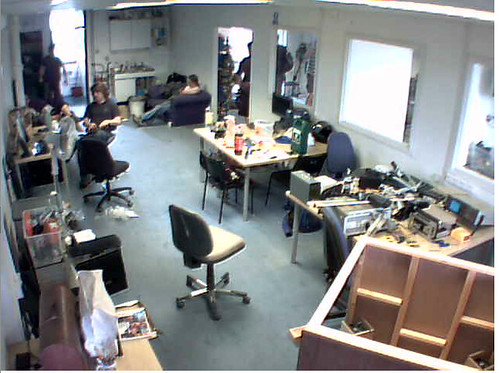
A typical dream of an active citizen scientist might be to have one’s own fully-equipment research laboratory and tinkering space conveniently established in one’s own garage or basement. Proper lab setup, either being a diy bio lab or an electronics lab or even a nuclear fusion lab, takes a great deal of planning, time, and at least some form of significant financial resource.
So, not everyone can implement personal lab spaces at home. And that is where the Hackerspace can be of assistance.
A hackerspace is a specialized open community lab where people with similar interests can meet, collaborate, experiment, and create. These are typically run as a membership organization with a board of directors and paying members, and many maintain non-profit 501(c)3 tax status. Although, Dynamic Patterns Research has not yet been directly involved with any particular hackerpace, the concept of this community format is exciting, and it is growing quickly in world-wide reach and popularity. Hackerspaces offer the essence of citizen science, and by distributing the burden of funding and management to the membership, they offer an accessible and efficient way for anyone to make their amateur research dreams come alive.
Hackerspaces.org (visit) provides an international online space for connection and collaboration between brick-and-mortar hackerspace organizations, and provides how-to documentation and support for those interested in joining existing groups or creating your own. Many of the existing hackerspaces focus on the “physical sciences”–namely, electronics, software development, and making machines that go “ping”! In a little more than one month, a San Francisco Bay-area hackerspace is attempting to gain enough funding to open a “biological” hackerspace called BioCurious. They have set up a Kickstarter project (visit) to help quickly grow interest in support, and if you live in the area you should check out the new group as they will likely provide a great, new opportunity for citizen scientists, as well as pave the way for the development of more “biohack”-spaces around the world.
For our friends in the UK, check out The Hackerspace Foundation [ VISIT ]
… …
UPDATE September 15, 2010: The BioCurious Kickstarter fundraising efforts reached its goal of $30,000 with seven days to go! Congratulations to the group, and we’ll be watching the progress.
Looking northeast around midnight on August 12th-13th; from NASA Science News
This week will include the peak evenings for the annual Perseid meteor shower. Although sky watchers have already seen a few exciting fireballs already, August 12 and 13 are expected to be the primary nights for viewing.
And this year, there will be an exciting pre-showing of planetary alignment in the west with Mars, Venus, and Saturn formed in a close triumvirate, and the crescent moon and Mercury a few clicks away (view a sky map). Once this special arrangement has set around 10 pm–which includes the Moon this year, so dark viewing should be optimal!–then the main attraction for the evening soon begins and will last until the Sun returns for the day.
The Perseids are pieces in the wide debris field left over from the 133-year cycle of Comet Swift-Tuttle. And, this comet is a big one, with a nucleus around 16.8 miles wide. The comet’s path follows particularly close to the Earth and Moon, and it was not long ago in 1992 that its calculated orbit was quite off from the latest observation. So far off that it was predicted that the next passage in 2126 could strike the Earth. Additional research was compiled to discover records of more ancient observations, and along with new direct observations puts the calculated orbit in safe distances for at least the next two thousand years.
On September 15 in the year 4479, humanity’s safety (or whomever or whatever is still hanging around the planet) might be more of a concern, however, as Comet Swift-Tuttle is predicted to come as close as 2.8 million miles. Certainly this moment is a way off, so hopefully we’ll have enough time to develop useful deflection technologies for such massive bodies. In the mean time, just sit back and enjoy the annual showing of Comet Swift-Tuttle bits burning up in our atmosphere.
You can track the calculated orbit of Comet Swift-Tuttle through the year 2201 with the JPL Small-Body Database Browser (launch the database of 109P/Swift-Tuttle).
… …
“Planets Align for the Perseid Meteor Shower” :: NASA Science News :: August 5, 2010 :: [ READ MORE ]
The re-emergence of the citizen scientist began a major fast forward in 1999. Scientists at the University of California Berkeley launched a new project to virtually connect millions of computers around the world to simultaneously process and evaluate radio signals from space. The gift wrapping of this program appeared to be a colorful and unique screensaver on a participant’s computer that would innocently chug along while sitting idle. The background of this program was working hard to identify subtle clues of the existence of intelligent life somewhere out in the cosmos.
SETI@Home was not the first kind of this software (a little history), but was the first popularized and most largely distributed computing application that allowed anyone with an internet connection to take part in real scientific analysis. Although over a decade later we’re still searching for life from above, the project is considered an amazing success. It technically harnessed so much computing power and processed the results in a way no other supercomputer of its time could compete with in both efficiency and–especially–cost.
Soon after the successful launch of SETI@Home, many more scientific applications were developed into the platform of distributed computing, and many more opportunities became available to the interested citizen. Evolutionary calculations, solving for drug designs to combat AIDS and cancer, analyzing data to extract the physical structure of the Milky Way, and the detection of gravitational waves all came along into the arena (and many more). In particular, an extraordinary complicated computational problem that scientists across many fields have been trying to make progress on for decades is that of protein folding; or, how does a random chain of amino acids (the building blocks of life on Earth) configure itself into complicated three-dimensional structures, the exact pattern of which determines its vital function.
The problem is one of minimization of energy where every given chain naturally falls into a coiled state that happens to require the least amount of energy to sit in that state. Consider how much energy it takes to play the game Twister, how much more energy it takes to win at Twister. Now, consider how much energy it takes to sit on the couch with your arms at your sides watching a favorite movie. Couch potato might be your personal configuration of a minimum energy state, while your contortions during Twister require uncomfortably high energy.
Nature seems to figure this problem out because it can’t do it any other way–if the protein “feels” too kinked up then it just flips into something more comfortable. But, human beings who want to understand the physics of this process are having a difficult time coming up with a clean mathematical representation of the experience of the protein. Computers–and their mighty brute force–are used to take a chain and calculate the energy required to maintain every possible configuration of the protein with the hope to then look back at all of the results of calculated energies and see which one has the smallest value. A rather straightforward approach, but the statistical possibilities for longer and longer chains become immense.
So, here is where human intuition has been coming into play. More recently, the protein folding team decided to integrate the power of the human mind into the calculation process. They developed a game system (visit Foldit) that allowed players–the citizen scientists–to gaze at a potential configuration of a protein. The edges requiring higher energies are highlighted and they can then “play” with the configuration interactively. With each tweak of the structure, the energies would be recalculated and displayed, and the human being could feel their way to a structure that seemed to carry the least energy. Sort of how nature might do it, too… without the obvious conscious observer, but rather in a more self-organized fashion.
The results of the game can actually be tested, as likely structures identified by the citizen scientists and recognized by the professional scientists can then be generated in the laboratory and monitored to see how stable the folded pattern actual is for that protein. In fact, the first academic paper has just been published, and the author list includes some of the actual citizen scientist players of Foldit.
“Citizen science: People power” :: Nature News :: August 4, 2010
So, it’s this “people power” through distributed thinking that is bringing new success to the critically important and painfully difficult computational problem of protein folding. Similar results are also being experienced by GalaxyZoo and their expanding platform of Zooninverse, where nearly 312,000 at home users help identify interesting astronomical structures or phenomena that require subjective classification decisions. The possibilities in these classifications are nearly endless, and programming an endless list of options into computer code is maybe not the most effective use of a computer scientist’s time.
Identification of phenomena in our amazing universe by coding is just not as effective as the slick, and subconscious intuition of the alert human brain. This is a unique skill that neuroscientists don’t even remotely understand, and it is certainly a skill obviously lacking in all computers. And, it is citizen scientists who are using their unique skill to actually drive computational research and development. These efforts will help scientists better understand what results intuition can bring, and possibly how to develop computational platforms to perform in similar ways.
Maybe then, citizen science will help bring us even closer to the inevitable Singularity Event (learn more about it), predicted to occur around 2050. It is this future time when the accelerating advances in computational power will surpass that of the human brain, and things will change dramatically. Computers will gain that unique, once human-only characteristic and will then continue–on their own–to further accelerate their own technology beyond that of human engineering. The final transitional technology that directs us to The Singularity will be the final invention of our species, and from that point on we will be connected in with a powerful force that will continue our evolutionary process at an incredibly high rate.
Maybe the further development of “distributed thinking” during the 2010’s will be the key technology for The Singularity to occur. Maybe citizen scientists around the world will play the critical role in the development of this technology. A fitting connection, of course, because it would represent the ultimate final experience of the evolutionary advantage that the homo sapiens hold over all other existing species; that of invention. As a massive collective effort, our species will together participate in an evolutionary development that will lead to a fundamentally new era in life on Earth. We will as citizen scientists work together to create and invent the next step in our own evolution, and with this will bring about the next version of the humanoid, Human 2.0.
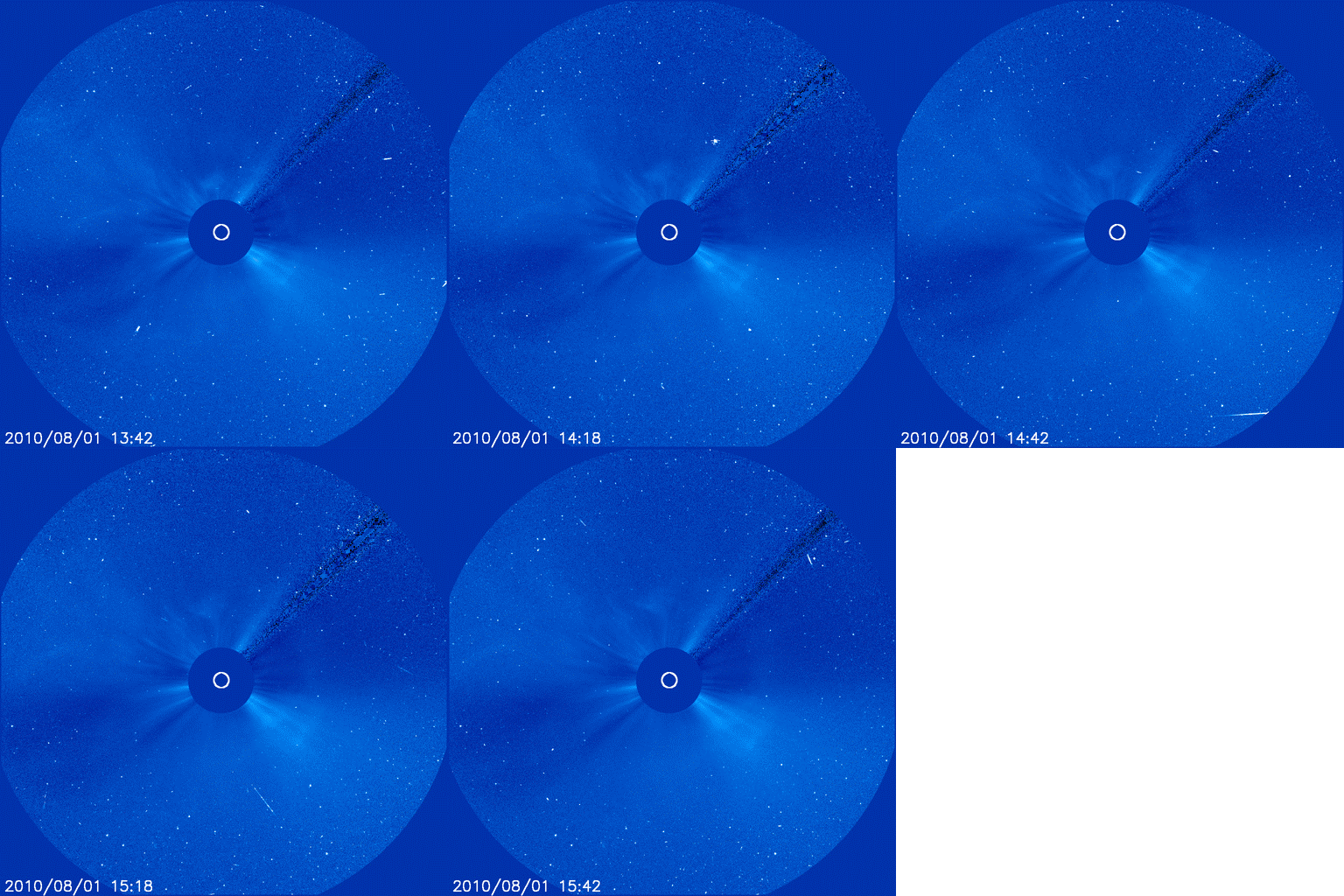
This morning a more unique solar event occurred from the current sunspot 1092. A class C3 solar flare was unleashed from this spot along with a nearly simultaneous magnetic filament stretching mostly across the sun’s northern hemisphere. The two events are likely connected by long-range magnetic fields.
The amazing and absolutely beautiful “solar tsunami” was captured in video by NASA’s Solar Dynamics Observatory…
along with the resulting coronal mass ejection imaged from SOHO…
Although a C3-class event represents minimal consequences on Earth, amateur astronomers and high-latitude sky watchers should be prepared for increased auroral activity around August 3rd.
This report comes from Dr. Tony Phillips at SpaceWeather.com posted August 1, 2010.
:: UPDATE AUGUST 2, 2010 ::
NASA’s Solar Dynamics Observatory has presented an updated video of the solar flare, where you can clearly see the filament lift off of the surface into space. [ WATCH QuickTime Video ]
The New York State Department of Environmental Conservation has a great collection of wildlife observation citizen science programs available. Currently, they feature eight projects that request wildlife observations from birders, hikers, hunters… anyone enjoying the great outdoors [LEARN MORE].
Right now during the month of August, the DEC is looking for observations from across New York State to help them estimate the average number of wild turkey poults (the young from this year) per hen. If you live in the state, please consider partnering with this program this month, and you may learn more about it below and use the Sighting Survey form (linked below) to submit your observations.
“DEC Seeks Participants for Summer Turkey Survey” :: readMedia :: July 29, 2010 :: [ READ ]
Review detailed guidelines and start your observations today… Summer Wild Turkey Sighting Survey form [ OPEN PDF ]
If you take part in this program during the month of August, please share with us here at Dynamic Patterns Research by commenting to on this article. We want to know about your experience!
The Cornell Lab of Ornithology–a premier citizen science research and support organization–is launching an exciting new program in the Fall of 2010. The Lab focuses most of its energy on aggregating and analyzing the efforts of thousands of volunteer citizen scientists to better understand the population and behavior of birds. Now, they are interested to better understand the habitats of birds, and not just the wild birds perched on remote mountain tops, but those right in your very own back yard.
The upcoming launch of YardMap.org will help researchers better understand the relationship between gardens, rural and urban greenspaces and the birds that live and thrive in these habitats. And, although it might at first seem odd to consider that your own yard would be considered a natural habitat, just remember that real nature creeps right up to your front door, and you don’t have to travel to exotic places to see and be a part of the real natural world.
The new interactive interface will use satellite imagery of your own green space as a canvas upon which you may overlay programmed images (or “avatars”) of vegetation and other features that you select to represent your yard. The system will then analyze your map and layout, and provide you feedback on the quality of your habitat and how yo can make it better for the birds.
YardMap will also act as a social media interface, and will allow other reporting habitat owners to communicate, review other layouts, and learn more about backyard habitats from others throughout the community of citizen scientists.
Sign up at the site and they will invite you to begin accessing the beta test of the system as soon as it is ready later this fall. We would like to learn about your experience here at Dynamic Patterns Research, so please let us know if you plan to participate.