Amateur Research

Observe the Close Encounter of Comet 103P/Hartley 2

Skimming by Earth as close as 11 million miles on October 20, the apparently young Hartley 2 comet will be nearly visible to the unaided eye. With binoculars, it will appear even better as a fuzzy, green blob, and a backyard telescope will offer excellent viewing. The next several days should be busy mornings for amateur astronomers, and will also be a great time for anyone to do some easy viewing of a special celestial event.

Head outside while it is still dark before sunrise, and look upward to the north. Passing through the constellation Auriga will be an unusual green blip from October 17 through October 20. If you are skilled in taking photographs… or, just want to give it a try!… please post your images on our Facebook page and tell us about how you took the image and what equipment you used. We are very interested to see the results from experienced amateurs as well as first-time astro-photographers.
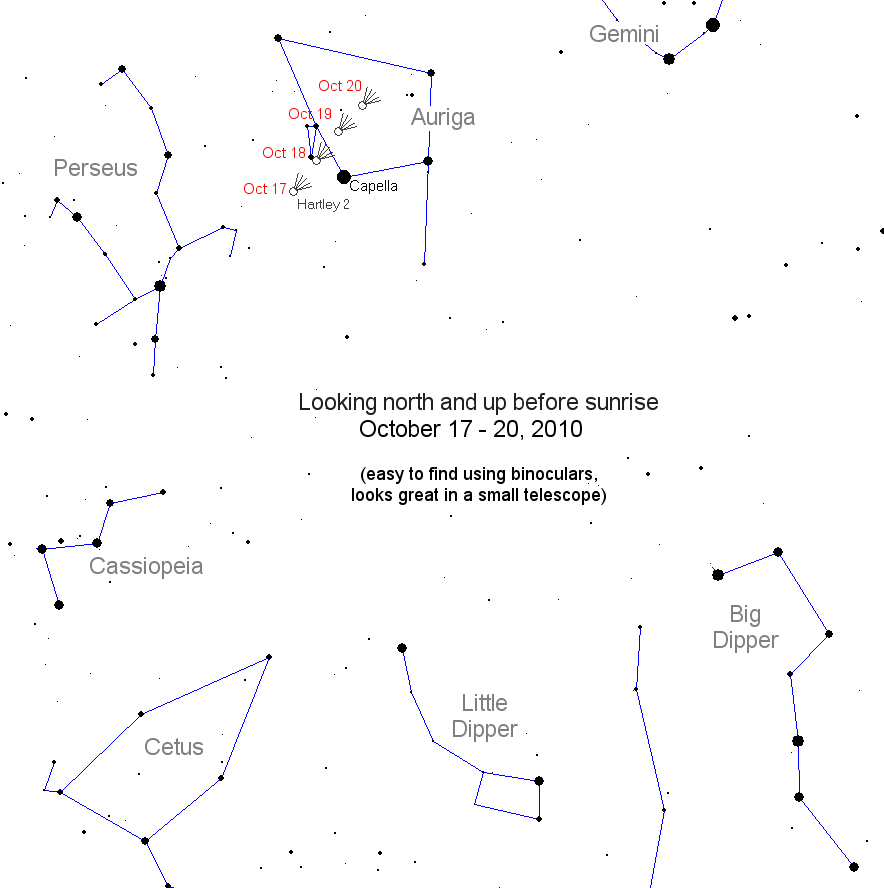
Sky map for Comet 103P/Hartley 2 on October 17 through 20
Sky map for Comet 103P/Hartley 2 on October 17 through 20. Courtesy Spaceweather.com

Discovered in 1986 by Malcolm Hartley, Comet 103P/Hartley 2 orbits the Sun about every 6 1/2 years. Based on current estimates of mass loss, it’s expected to last for another 700 years. [ READ MORE ] What’s particularly interesting about this comet is that it is relatively small–just less than a mile in diameter–but the nucleus is still very active. On November 4, 2010, NASA’s Deep Impact/EPOXI spacecraft will venture only 435 miles away from the comet to frantically take images and data about the unique comet. At this point in the comet’s orbit, it will be about at its closest approach to the Sun, called the perihelion distance, and the ice formed during it’s long journey in the outer solar system will be vaporizing at rates that are much higher than other previously observed comets. EPOXI will be close enough to take stunning images of out-gassing, and it will potentially observe physical features directly on the surface of the nucleus at a resolution of 7 meters per pixel.

Orbit Diagram of Comet 103P/Hartley 2 generated from NASA's JPL Small-Body Database Browser
Orbit Diagram of Comet 103P/Hartley 2 generated from NASA's JPL Small-Body Database Browser.

This study is so important because Hartley 2 will be only the fifth comet nucleus viewed up close and personal by NASA. And, comets are critically important because they represent untouched remnants from the formation of our solar system. These chunks of pre-system debris did not get sucked into a forming planet long ago, so they contain material that was present way before even the Earth started preparing itself for the development of life.

Be sure to learn more about this exciting Comet 103P/Hartley 2 and how NASA is preparing to study the orbiting body [ READ MORE ]. Take the time this week to head out in the early morning and look up for the green, glowing blob that might prove to be a treasure trove of new scientific understanding.

Observe the Close Encounter of Comet 103P/Hartley 2 Read More »

Creepy Crawly Citizen Science Down Under

Citizen Science throughout the Southern Hemisphere has been growing recently, in particular with thanks to increasing efforts in Australia. In fact, Dynamic Patterns Research has just updated an Australia Regional list in our Opportunities section to feature some of these exiting new programs (view).

The most recent event, just launched on September 1, 2010 and sponsored by the citizen science-centric Australian Broadcasting Company and radio station 891 ABC Adelaide, is Operation Spider. This new “down under” citizen science program hopes to encourage people to get to know their crawly co-inhabitants, and report to the program what species of spiders exist in their spaces and how they behave when encountering a spider. (Yes, part of this research is to understand human behavior as well as the spiders!)

The main element of the project asks Southern Australians to complete a two-part online survey. First, is a review about how the observer feels toward spiders, and asks specific questions about how one would behave when encountering a specific species of spider. For example, if you see a daddy-long-legs in your living room would you (a) kill it yourself, (b) have someone else kill it for you, (c) “rescue” it and take it outside, (d) or leave it alone.

Second, the survey includes a worksheet to use while perusing your house and garden for recording observations of specific spiders. Images of certain anticipated species are available to assist in identifications.

Steve Donnellan and Chris Daniels presented a spider information talk to students from Rostrevor, Eden Hills and Belleview schools. (Brett Williamson)

View more images of the launch of Operation Spider on September 1, 2010.

An informative set of six Fact Sheets have also been developed to provide a nice range of educational materials for learning about spiders in Southern Australia. These include a general introduction to invertebrates and their evolution, how spiders live, eat, and make webs, and information on specific species that are expected to be found.

For the compositionally-creative citizen scientists, Operation Spider is also hosting a spider Poetry Competition. They are looking for 8-line short poems about spiders, and winners from four categories will be awarded a spider “prize pack” (valued at over $100!)

If you live in the southern “Down Under,” then start getting friendly with your spider neighbors, and take part in this fun citizen science project. The next time you want to squash an eight-legged crawly creature, you might discover that your feelings have changed from murderous to creepy affection!

… …

Operation Spider Fact Sheets [ VIEW ]

Operation Spider Survey from the University of South Australia [ VISIT ]

Operation Spider Poetry Competition [ SUBMIT ]

Creepy Crawly Citizen Science Down Under Read More »

The Great World Wide Star Count 2010

The 2010 Great World Wide Start Count date has been set! A Windows to the Universe citizen science event, you can join with thousands of other people across the globe anytime from October 29 through November 12 in looking up to see how many stars you can see.

Last year, Dynamic Patterns Research participated (read more), and it was a great opportunity for father and 3 1/2-year old daughter to count, compare, learn about constellations, and start to think about the ridiculous notion that we are part of a universe that is so unfathomably enormous.

The goals of this program are to raise awareness of light pollution in your area and to increase the interest of the broader public in learning more astronomy. Developed by the National Earth Science Teachers Association (NESTA) and the University Corporation for Atmospheric Research (UCAR), the Windows to the Universe Great World Wide Star Count is in its fourth year of data collection, and should continue to grow as a very interesting research resource for monitoring the evolving night-time global landscape of light output.

In fact, you can now take a look at the results from the previous three years [ VIEW DATA ], and begin to search for patterns and correlations between how many stars were seen and expected light output from the area. You might find initially, however, that the data is still very sparse, and for this resource to be particularly useful, a much larger set of results really will be required.

Since the data is also provided as a Google Earth KMZ file (download 2007, 2008, 2009), it’s very interesting to overlay the set with a light pollution map (download a North America map). As an example, we’ve completed a simple North American map overlay using Google Earth, and focused into our own data point in Illinois that we provided last year:

The darker the blue of each “data point dot” corresponds to more stars seen at the observation location. So, it seems that there are pretty dark dots at locations that would be expected to have lower visibility. However, this array of data is such a small data set to consider at this time that it is difficult to make any obvious conclusions. But, the potential to use more of this data to support very interesting and useful analysis should be apparent. And, all of the data is entirely accessible to the citizen scientist, so we can easily explore and consider the results.

When planning to make your own observations anytime between October 29 and November 12, all you need to do to prepare is a little stretching out of your neck for looking up (or, find a nice blanket to lie down on your back and view in comfort). If you live in the northern hemisphere, then gaze toward the constellation Cygnus, and toward the constellation Sagittarius if in the southern hemisphere. Simply “count” the stars that you can see at your location–or estimate the visual field that you observe–and match your viewing with the reference magnitude charts provided by the program. Then, simply report your observation online along with your latitude and longitude coordinates (find where you’re at on the globe). If you have any questions on how to participate, please feel free to comment here or contact us.

Learn more about star apparent magnitude [ READ :: READ :: READ ]

Please let us know if you plan to participate in this year’s count, and especially if you are interested in creating any of your own analysis of the results. The project really needs a significant increase in participation to provide a meaningful data set, so please spread the word to your friends and colleagues who you can encourage to join.

We would like to develop a team of citizen scientists who not only want to submit their own observation, but who also want to do an independent analysis on the annual global results. We will then present your thoughts and observations right here on Dynamic Patterns Research.

The Great World Wide Star Count :: October 29 through November 12, 2010 [ VISIT ]

The Great World Wide Star Count 2010 Read More »

NSF Features Citizen Science and NestWatch

The National Science Foundation‘s online magazine, Science Nation, features the latest efforts from the Cornell University Lab of Ornithology expanding citizen science program. Lab director and ecologist, Janis Dickinson, discusses how successful the fields of ornithology and astronomy have been in matching professional research activities with hobbyists who thoroughly enjoy doing what they do and simultaneously helping the advancement of science.

In particular, the Lab has been collecting data on nesting events of birds since the 1950s through their Nest Record Card Program. These records are still filed away on little, worn index cards written by amateur observers, but include valuable nesting data, including basic climate information, for the great, great, great, great grandparents of birds in the wild today.

With the funding assistance of the National Science Foundation and the collaborative development from Cornell and the Smithsonian Migratory Bird Center, nesting event data collection has moved into the current century with NestWatch. This online, citizen science data collection tool is an efficient method for anyone interested to learn how to monitor the activity from backyard bird nests, report observations, and explore the activity from other citizen scientists all around North America (view an interactive map of the data).

Simple certification is required before submitting observations, but once set up with an account, anyone using NestWatch will have a great opportunity to help support research that is a critical component to global environmental monitoring. The program is also perfect for families and schools to work with an at-home project that is fun and can lead to many educational moments through spending time outside and looking for bird species and behaviors that you may never have witnessed before.

“Citizen Science” :: A special report from NSF’s Science Nation :: August 30, 2010 :: [ READ ]

Register your backyard nest site with NestWatch [ VISIT ]

NSF Features Citizen Science and NestWatch Read More »

Perseid Meteor Shower from Your Couch

This August was the annual Perseid Meteor shower (read more from DPR), and hopefully you had a chance to catch a flash, or two. However, if it was just too inconvenient for your schedule–yes, some of us do have to work in the morning!–or, if getting away from the city lights costs too much at the gas pump, then, thanks to the skills of many amateur astro-photographers (learn how to become one yourself), you may still view the shooting beauties from the comfort of your computer monitor.

Spaceweather.com presents a great photo gallery collection of images submitted from observers from all over the world [ VIEW ]. Here’s an amazing image from Jeff Berkes who was apparently on his honeymoon…

Perseid meteor over Poi Pu, Kauai from Jeff Berkes.

You may also review the Perseid 2010 report compiled by the International Meteor Organization [ VIEW ], which includes an interesting graph of reported observation rates.

And finally, photographer Henry Jun Wah Lee of Los Angeles and Evosia Photography, completed an interesting time-lapse videos of Perseid meteors with the inspiring backdrop of the galactic center of the Milky Way…

So, enjoy these great views of falling debris from previous near-passes of Comet Swift-Tuttle, and maybe consider planning a late evening or two next year far out from the city and try to catch a few memorable Perseids yourself.

Perseid Meteor Shower from Your Couch Read More »

Jellyfish Reporting by Citizen Scientists in Malta

The upside-down jellyfish is an uncommon species recently found around the Maltese Islands; from Spot the Jelly Fish

Growing up in the Midwest of the United States, and taking several trips over my lifetime to an Atlantic or Gulf of Mexico beach, I recall the vague consideration of the floating jellyfish. Maybe it’s hard to see them, but they will hurt a lot of you touch one of their venomous cells. And, there were certainly few horror stories that need not be transcribed here. Watching the Pixar classic “Finding Nemo” provides a daunting realization–albeit digitally conceived–of the beauty and the devastation of the jellyfish bloom.

Apparently, the jellyfish population in the Mediterranean Sea is of considerable concern to scientists, tourism officials, and beach combers alike. So much so, the Island of Malta has established a citizen science program to track the common and not-so-common jellyfish populations that surround their little paradise (visit). Lead by the University of Malta and the IOI-Kids of the International Ocean Institute, the “Spot the Jellyfish” program engages children, teachers, parents, and tourists to keep a keen eye out for the gelatinous monsters.

An incredible array of species have already been identified all around the islands, including the the surface-dwelling blue button (Porpita porpita), the cigar jellyfish (Olindias phosphorica), the comb jellies (ctenophores), the mauve stinger (Pelagia noctiluca), and the jelly-like invertebrate, the Portuguese_Man_o’_War.

Portuguese Man-O-War (Physalia physalis); Courtesy Wikimedia Commons.

If you stare at images of these amazing creatures long enough, you might start considering that you live on another planet or are from a very different epoch of Earth’s history. They are such interesting creatures, yet they don’t seem to make much sense with their transparent, floating-with-the-current routine. Despite this thought, the species are numerous and they flourish in their blooming communities around the entire globe. So, somewhere along the time line, evolution found them to be stable, useful organisms.

An interactive map of the identified jellies around Malta–including those with and without stingers–is presented online (view) with reporting from within the previous twenty-four hours. Not only, then, can this be a vital research tool for better understanding the population dynamics of jellyfish species in the region, but it can also be used by tourists and locals wanting to take a break in the waves as to what sort of species have been recently observed.

In addition, the dynamic nature of the jellyfish blooms with respect to ocean climate, is not fully understood. Claudia E. Mills of the University of Washington has been studying these little buggers for over three decades, and is trying to determine what sort of impact regional ecological changes are having on species of jellies. With populations exploding in some areas and decreasing in others, a sort of species filtering might be underway. However, a better understanding of the connection between the local ecologies and the species must be developed first to predict the future of the jelly fish. Organized citizen science activities certainly can support this sort of research, and the Maltese program would provide a thorough template for a successful outreach to the public and their mass data collection efficiencies.

… …

“Jellyfish campaign reports uncommon species” :: TimesOfMalta.com :: July 30, 2010 :: [ READ ]

Spot the Jellyfish – An IOI-Kids Initiative :: [ VISIT ]

“Jellyfish blooms: are populations increasing globally in response to changing ocean conditions?” Mills, C. E., Hydrobiologia 451: 55–68 (2001) [ DOWNLOAD and READ pdf ]

:: UPDATE August 25, 2010 ::
TIME Magazine online featured a nice review report of Jellyfish citizen science activities in the Mediterranean:
“Stinging Season: Can We Learn to Love the Jellyfish?” :: TIME Magazine :: August 20, 2010 :: [ READ ]

Jellyfish Reporting by Citizen Scientists in Malta Read More »

Last updated March 17, 2026