Science at Home

Perseid Meteor Shower from Your Couch

This August was the annual Perseid Meteor shower (read more from DPR), and hopefully you had a chance to catch a flash, or two. However, if it was just too inconvenient for your schedule–yes, some of us do have to work in the morning!–or, if getting away from the city lights costs too much at the gas pump, then, thanks to the skills of many amateur astro-photographers (learn how to become one yourself), you may still view the shooting beauties from the comfort of your computer monitor.

Spaceweather.com presents a great photo gallery collection of images submitted from observers from all over the world [ VIEW ]. Here’s an amazing image from Jeff Berkes who was apparently on his honeymoon…

Perseid meteor over Poi Pu, Kauai from Jeff Berkes.

You may also review the Perseid 2010 report compiled by the International Meteor Organization [ VIEW ], which includes an interesting graph of reported observation rates.

And finally, photographer Henry Jun Wah Lee of Los Angeles and Evosia Photography, completed an interesting time-lapse videos of Perseid meteors with the inspiring backdrop of the galactic center of the Milky Way…

So, enjoy these great views of falling debris from previous near-passes of Comet Swift-Tuttle, and maybe consider planning a late evening or two next year far out from the city and try to catch a few memorable Perseids yourself.

Perseid Meteor Shower from Your Couch Read More »

Get Ready for the Perseid Meteor Shower this Week

Looking northeast around midnight on August 12th-13th; from NASA Science News

This week will include the peak evenings for the annual Perseid meteor shower. Although sky watchers have already seen a few exciting fireballs already, August 12 and 13 are expected to be the primary nights for viewing.

And this year, there will be an exciting pre-showing of planetary alignment in the west with Mars, Venus, and Saturn formed in a close triumvirate, and the crescent moon and Mercury a few clicks away (view a sky map). Once this special arrangement has set around 10 pm–which includes the Moon this year, so dark viewing should be optimal!–then the main attraction for the evening soon begins and will last until the Sun returns for the day.

The Perseids are pieces in the wide debris field left over from the 133-year cycle of Comet Swift-Tuttle. And, this comet is a big one, with a nucleus around 16.8 miles wide. The comet’s path follows particularly close to the Earth and Moon, and it was not long ago in 1992 that its calculated orbit was quite off from the latest observation. So far off that it was predicted that the next passage in 2126 could strike the Earth. Additional research was compiled to discover records of more ancient observations, and along with new direct observations puts the calculated orbit in safe distances for at least the next two thousand years.

On September 15 in the year 4479, humanity’s safety (or whomever or whatever is still hanging around the planet) might be more of a concern, however, as Comet Swift-Tuttle is predicted to come as close as 2.8 million miles. Certainly this moment is a way off, so hopefully we’ll have enough time to develop useful deflection technologies for such massive bodies. In the mean time, just sit back and enjoy the annual showing of Comet Swift-Tuttle bits burning up in our atmosphere.

You can track the calculated orbit of Comet Swift-Tuttle through the year 2201 with the JPL Small-Body Database Browser (launch the database of 109P/Swift-Tuttle).

… …

“Planets Align for the Perseid Meteor Shower” :: NASA Science News :: August 5, 2010 :: [ READ MORE ]

Get Ready for the Perseid Meteor Shower this Week Read More »

Solar Flare Alert C3-Class with Video

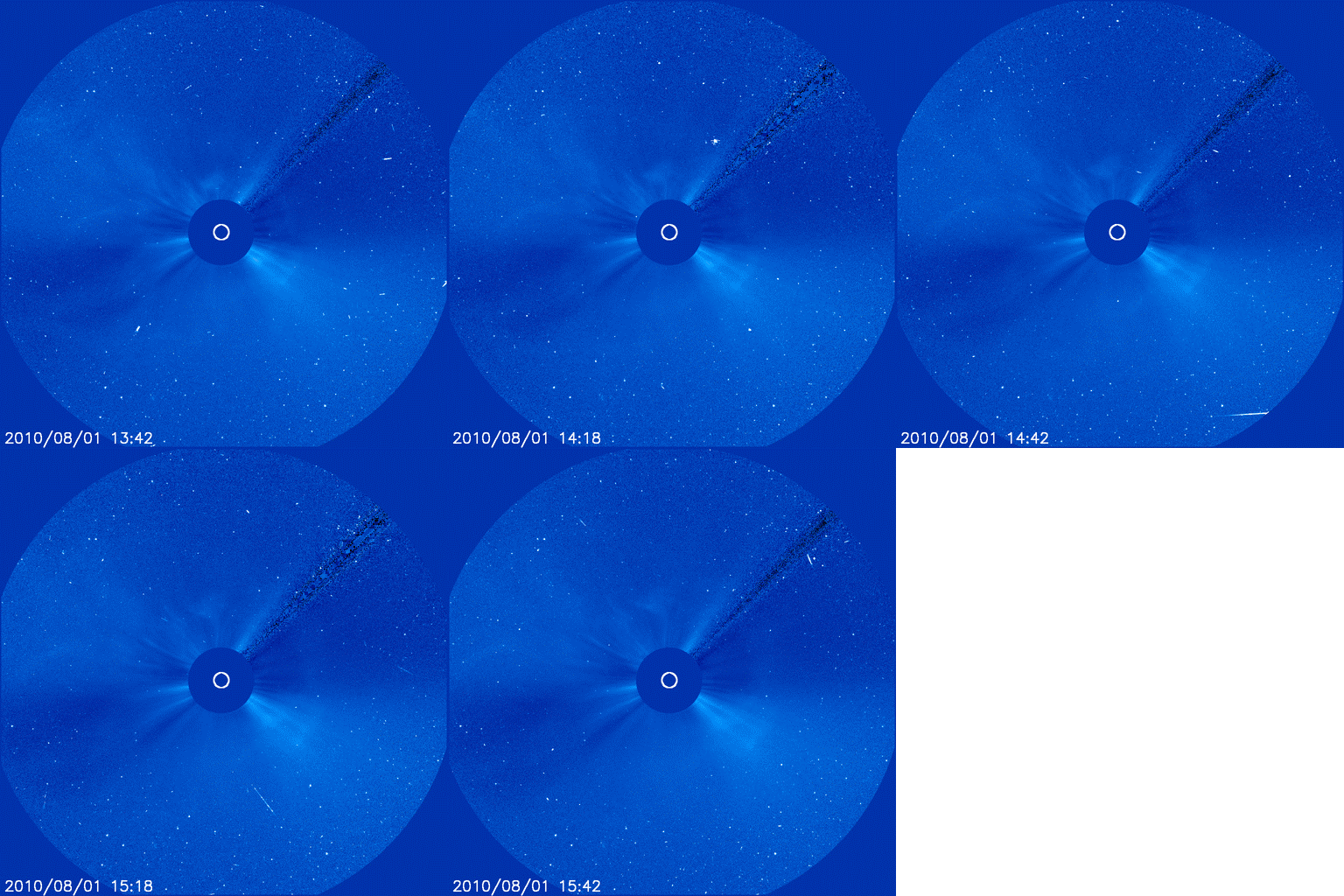
This morning a more unique solar event occurred from the current sunspot 1092. A class C3 solar flare was unleashed from this spot along with a nearly simultaneous magnetic filament stretching mostly across the sun’s northern hemisphere. The two events are likely connected by long-range magnetic fields.

The amazing and absolutely beautiful “solar tsunami” was captured in video by NASA’s Solar Dynamics Observatory

Sunspot 1092 Eruption Video (Watch Video – mpg)

along with the resulting coronal mass ejection imaged from SOHO

Although a C3-class event represents minimal consequences on Earth, amateur astronomers and high-latitude sky watchers should be prepared for increased auroral activity around August 3rd.

This report comes from Dr. Tony Phillips at SpaceWeather.com posted August 1, 2010.

:: UPDATE AUGUST 2, 2010 ::

NASA’s Solar Dynamics Observatory has presented an updated video of the solar flare, where you can clearly see the filament lift off of the surface into space. [ WATCH QuickTime Video ]

Solar Flare Alert C3-Class with Video Read More »

Virtual Birding from South Texas

Part of the enjoyment in birding includes directly experiencing nature, taking your time, breathing, listening, watching each rustle in the trees, and listening some more. Part of the limitations, however, might be that you only can experience your back yard, you don’t have enough financial resources to travel around the world chasing exotic species, or you just don’t have enough time to escape the real world long enough to enjoy the birds.

From an environmental scientists’ perspective, a significant limitation to monitoring the long-term bird activities and population in an extended area is the extensive people-hours required in waiting around to breath, listen, watch each rustle in the the trees, and then listening some more.

Some of these limitations can now be removed with a little creative technology in imaging and Internet-based process control with a new system referred to as a Networked Tele-Robotic Observatory Game. The new citizen science program located in southern Texas is the result of a collaborative effort between the Welder Wildlife Foundation, the Smithsonian National Zoological Park, Texas A&M’s Prof. Dezhen Song, UC Berkeley’s Prof. Ken Goldberg, and the National Science Foundation.

Visit the CONE (“Collaborative Observatories for Natural Environments”) site linked below, and within minutes you can be taking live images of birds enjoying the day at Welder. All you need is an email address, and it would be highly appropriate to watch the video tutorials before taking over the remote camera control from the other participants.

“Virtual birding available at Welder Wildlife refuge” :: Victoria Advocate :: May 28, 2010 :: [READ with video]

CONE at Welder Wildlife Refuge
:: [ VISIT ] :: [ ABOUT ] :: [ TUTORIAL ] ::

DPR is very excited about this remote laboratory project, and will be including it in our official recommendations of eLabs for Citizen Scientists. If you spend some time with CONE at Welder, or are aware of other similar virtual laboratory opportunities, please let us know so that we may all learn from your experiences.

Virtual Birding from South Texas Read More »

Wolfram|Alpha brings Powerful Computation to Everyone

Stephen Wolfram has spent his life to date — and will likely continue to do so — developing amazing new computational technologies to empower scientists and academics to more efficiently and effectively compute their way through their research, and even help them to make a few discoveries along the way.

Now, Wolfram and his company’s decades worth of computational development are being reimplemented into a simple user interface that is accessible to anyone who can ask a question. In particular, the ultimate goal of Wolfram|Alpha is to — simply! — “make all systematic knowledge immediately computable and accessible to everyone.” This platform is under continuous development and hopes to “compute whatever can be computed about anything.”

Pause for a moment and just think about that goal once again: “compute whatever can be computed about anything.” After soaking in these thoughts, you may now raise your jaw back into it’s closed and upright position.

This resource will be especially useful to citizen scientists who need quick references to factual data that can be trusted. (References are included with the computed results.) Moreover, an exciting feature of the output from a Wolfram|Alpha query is that it not only tries to provide you with a specific result, but it also explores the results to potentially bring you additional information, background, and even comparisons that you might not have considered in your original question.

Enter any mathematical expression, and a whirlwind of results will be presented, ask about what drugs are used to treat a medical condition, say Multiple Sclerosis (try it), ask about the temperature in your city (try it) and you’ll have current temperature and historical data graphed for you for 10 years or more, find out how much oil has been spilled in the Gulf of Mexico (try it), type in your birth date (try it) and discover not only how old you are, but other famous anniversaries and the sunrise, sunset, and moon phase for that day in history. Examples of what you could possibly discover with Wolfram|Alpha are infinite [ EXPLORE EXAMPLES ], and the results that you will find are so much more direct, powerful and efficient than what you could ever find googling random web sites.

So, I encourage you to dive in and try out this exciting resource (download the iPhone app), and consider it when you need to find real answers to your real questions while doing your real amateur research. And, if you discover something particularly interesting, please post here to let everyone experience the wonders of computation with you.

Explore Wolfram|Alpha now…
Enter your question to computer in the Wolfram|Alpha Search Box at the right column –>

Wolfram|Alpha brings Powerful Computation to Everyone Read More »

The New Make: Science Room for At Home Amateur Research

The ultimate do-it-yourself and hack-your-way-to-happiness magazine, MAKE, recently launched a new section to their Make:Online website just for supporting the at home citizen scientist.

Having just subscribed to the online version of the magazine, I am excited to see the additional resources that Make is developing to actually support the education of amateur scientists with this guide for entering into the world of science at home. The focus at this time is on at home chemistry projects, and will help you take your old children’s chemistry set experience to the next level in your garage (or basement, or laundry room).

Even if you are not particularly interested in doing chemistry at home–and bringing in the possibility of causing glass beakers go “Bang!”–the online resource will still provide a valuable educational experience to help you think about the process of setting up an at home lab–for any project–and what all should be considered in the process.

If you have setup your own at home lab, or are planning on venturing into this exciting opportunity of at home science labs, then tell us about your experiences here on DPR AmSci Journal!

Make: Science Room [ VISIT ]

The New Make: Science Room for At Home Amateur Research Read More »

Last updated March 17, 2026