Author name: Matthew T. Dearing

Design Your Own Zooniverse Project

The extreme popularity and continuing scientific success of Galaxy Zoo and the subsequent explosion of the many Zooniverse projects have brought useful and important scientific research to the masses of interested citizens from around the world. Dynamic Patterns Research continues to support these awesome efforts, and is currently actively involved in the Planet Hunters program. Zooniverse has been adding new projects at an impressive rate–there are ten live projects now–and they apparently have no plans to slow down. In fact, they are now looking outward to the very group of people who processes their masses of data to brainstorm the next big citizen science project to be developed.

Citizen Science Alliance

Hosted through the Citizen Science Alliance and with support from the Alfred P. Sloan Foundation and the Adler Planetarium, Zooniverse has announced an open call for proposals for future scientific projects that would benefit from the collective, analytical efforts of hundreds of thousands of remote volunteers. The proposals would need to have a direct connection with a scientific or research group, but the ideas should also be able to flow from citizen scientists themselves.

The next selection round of ideas will occur in January 2012, so plan on completing your submission in December 2011. If you are not familiar with the great Zooniverse projects, take some time to directly experience how powerful they are and the potential that the platform can have for so many other serious scientific questions that can only be successfully answered with the critical help from citizen scientists around the world.

Begin Your Submission

Design Your Own Zooniverse Project Read More »

fEITER image of an anaesthetised brain.

A Live View of Unconsciousness

It’s difficult to know what you are thinking — or what is happening in your own brain — as you loose consciousness. There are many instances where this loss might happen, including getting whacked up side the head, inhaling a large volume of non-medically-inspired drugs, or, to the preference of many, falling into a deep sleep during anesthesia before an invasive operation.

Many research groups have studied the brain during its influence to anesthetic drugs, in particular Stuart Hameroff from the University of Arizona. The brain seems to become almost numb and nearly shuts down entirely, enabling trained professionals to freely cut into the human body without the distraction of painful screams and cries for help from the patient. But, this is a rather interesting phenomena, that is not entirely understood.

fEITER image of an anaesthetised brain.
Reconstruction of the brain during the onset of anaesthesia. CREDIT: University of Manchester via LiveScience.com

Directly watching the brain as it slips into unconsciousness would certainly be an interesting approach to trying to solve not only the mysteries of anesthesia, but to also better understand what it means for the brain to be conscious, or at least aware. Now, with a new observational technique developed by the University of Manchester, called functional electrical impedance tomography by evoked response (fEITER), the attempt is underway to create live views of the brain’s electrical activity as it shuts down from anesthetic drugs. With this near real-time recording, the research team, lead by Brian Pollard, Professor of Anaesthesia at the University of Manchester, is hoping to learn more about the differences between an unaware and aware brain and how these differences might lead to a better understanding of what the phenomenon of consciousness really is for human beings.

Notice, here, that a subtle change of words was made from “consciousness” to “awareness” and back again. This difference seems to be important, however, and should not be used lightly. A brain might be considered “aware” of its surroundings by responding to pain being induced on its body, or to the intense colors and lights surrounding its head during a walk through Times Square in New York City. But, a simple diode light sensor switching off an automatic garage door motor might also be considered to be “aware” of the puppy dog running through its beam just before the door touches ground.

So, what seems to be an additional specialty to humans is that our brains are more than just aware. There is something more to consciousness; something to being self-aware. Or, maybe not… we just don’t understand, yet. However, the real-time, three-dimensional electrical views generated by fEITER devices should provide some extremely interesting comparisons between the aware and unaware brain. And, it is seemingly from this awareness that emerges our sensation of consciousness, so understanding the electrical requirements for awareness is an important step to understanding the neural correlate of consciousness.

“3-D Images Reveal What Happens as Brain Loses Consciousness” :: LiveScience :: June 10, 2011 [ READ ]

A Live View of Unconsciousness Read More »

From here to infinity, Mothers create the most amazing things in the Universe.

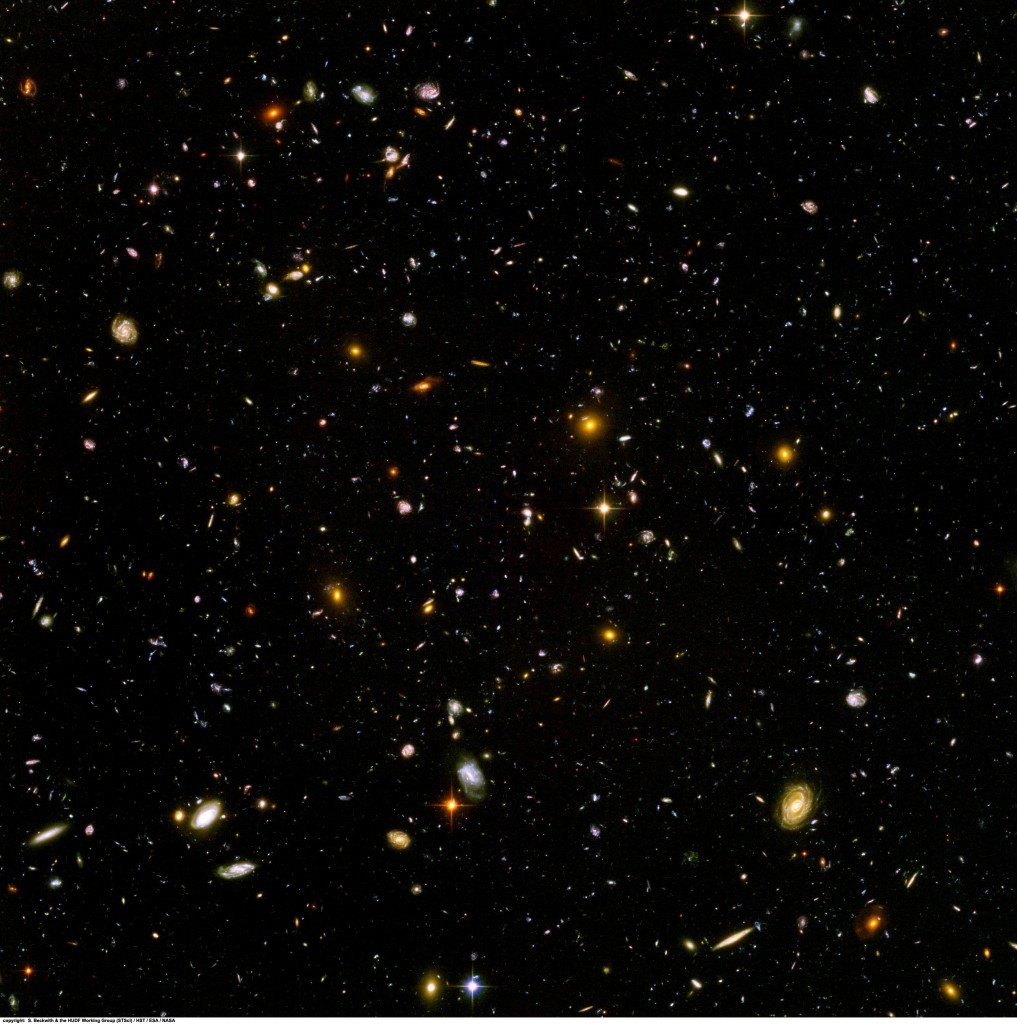
The HUDF includes galaxies of various ages, sizes, shapes, and colors. The smallest, reddest galaxies, are some of the most distant galaxies to have been imaged by an optical telescope, existing at the time shortly after the Big Bang.

The Hubble Ultra Deep field image, taken in 2003, is considered to be the most amazing image ever created by human beings. A direct view of the Universe 13 billion years ago, it contains over 10,000 galaxies, each of which can contain 100 billion stars, or even more.

The enormity of what this image represents is so awesome and so amazing, it’s really impossible for any one human being to comprehend not only its meaning, but that it can actually be.

And, although this image represents something so spectacular, there is still another image closer to home that is infinitely more special to me, as a husband and father. This might be because it is actually possible to comprehend its meaning, it is possible to understand that it is real, and it is felt deep within my heart that it is the most important and wonderful thing that exists in the Universe.

My two children, now five and two years old, are amazing, and it is simply incredible that they exist. There is almost nothing more exciting and wonderful than the fact that these two children were created and will grow up to be fabulous human beings.

My sense of wonder and awe is amplified because of my many previous experiences with wonder and awe while I’ve spent many years of my life learning about how the Universe works, experimenting in that Universe, and trying to express these exciting understandings to others. As a citizen scientist who thoroughly enjoys a continuous advancement of ones own appreciation and understanding of Nature, it is all that more satisfying to be able to share this appreciation with ones own children.


Sister and Brother, the Princess and Prince.

But, what is even more amazing than my children is that my wife, Michelle, created them. What she went through to nurture these babies and bring them both into the world was absolutely insane. And, this is what makes her so incredible. This is what makes all mothers quite incredible. I think that my wife is so amazing for having created our children and this is one reason why I love her more than anything else. It really was an outstanding feat, and only she could have done it: no one else in this infinite Universe could have created exactly our children. They would never have come to be without my wife, and their entire lives and our lives together as a family could have never existed with her.


There is no other image ever created in all of human history that is more important to me than an image of our children. And, my wife is the one who made that all possible. No one else could have done this amazing thing for me, and that makes her such an absolutely incredible person.

With much love on Mother’s Day.
Matthew T. Dearing

From here to infinity, Mothers create the most amazing things in the Universe. Read More »

Citizen Scientists to Map Biogeography of Microorganisms Across United States

The Astrobiology Research Center at Penn State is currently developing a pilot citizen science program to study the diversity of microbes that live in your home hot water heater. The goal of this initial project is to test their approach for bridging citizen scientists volunteers with microbiology, as well as to create an initial “map” of the diversity of microorganisms across the United States.

The research group is looking for only two volunteers from each state at this time. If you would like to participate, simply register online.

View the Project Flyer (pdf)

Citizen Scientists to Map Biogeography of Microorganisms Across United States Read More »

NASA Collaborates with Citizen Scientists as a New Approach to Success

It’s a great thing to be able to do real science on your own, and this is exactly what we encourage here at Dynamic Patterns Research. But, it’s even another great thing to be able to help inspire the desire to do real science in someone else. This is where a great new partnership between NASA, Teachers in Space, and MAKE Magazine is focused to bring exciting scientific experience to young minds.

The goal of the new “NASA Make: Challenge” is to solicit the ingenuity of makers and amateurs to develop inexpensive kits that can be built by students and then sent off into suborbital flights to perform some scientific experiment.

The deadline for submission of ideas is fast approaching on April 30, 2011 and the rules and guidelines are posted online.

This program is planned to be a multi-year event, but the first winning kit designs will be initially assembled by teachers at a workshop at the NASA Dryden Flight Research Center’s AERO Institute in Palmdale, CA in early August 2011. These kits will then fly aboard the Excelsior STEM mission, which is an unmanned suborbital flight scheduled to fly aboard a Masten Space Systems reusable launch vehicle later in 2011.

NASA Make: Challenge Webcast from MAKE magazine on Vimeo.

… …

This wonderful partnership is a great example of NASA’s new approach to finding success in the socially-connected and cash-strapped early 21st Century. As it becomes clear and ever more important that NASA must continue to evolve as a collaborative partner in space exploration and cutting-edge research (read the 2011 NASA 2011 Strategic Plan), they are also increasing their emphasis on partnerships with a broader base of academic institutions as well as directly approaching the exploding citizen science community. In particular, NASA’s new Open Government Initiative, just released last year and is now under development even though “openness” was part of their original 1958 founding legislation, is creating an updated culture of connection between their scientists and engineers and the rest of the country’s citizenry.

The Cover of the NASA Open Government Plan
Read the NASA Open Government Plan

This renewed energy from NASA should be a boon to those citizen scientists interested in finding more direct ways to collaborate with the exciting scientific resources and research fields that NASA is mandated to tackle. Although created by an academic middle-man from the UK, Chris Lintott, the exploding Zooniverse of citizen science projects is the greatest example right now of the successful connection between NASA-generated data (through the Hubble Space Telescope, the Kepler Mission, the Spitzer Space Telescope, the Lunar Reconnaissance Orbiter, and the STEREO Space Observatories) and the important scientific analysis performed by volunteers from around the world. NASA is proud of these endeavorers, and readily brags about the progress (“Citizen Scientists Making Incredible Discoveries“, NASA Science News, April 22, 2011).

NASA wants to provide critical tools for citizen scientists. It is not only an aspect of their mandate to be an open source scientific resource, but the valuable role that citizen scientists now play in the advancement of science is becoming more clear each and every day. NASA wants to be successful, and they know that they must collaborate with the private sector and the private citizenry to help become what they want to be, especially since the US Congress struggles every year to fund this much needed success.

NASA's Tools for the Citizen Scientist
NASA's first-year progress toward their new plan of being an Open Government Scientific Resource.

As a seasoned citizen scientist, or if you are wanting to simply whet your appetite for scientific adventures and informal self-learning, the time is ripe now to connect with NASA and take a direct part in the rapid development of new technologies and exciting scientific discoveries that are happening right now and will happen in the near future.

Please let us know at Dynamic Patterns Research what sort of connections you have made or are in the process of developing so that we might learn more about the great new opportunities that could be out there for other citizen scientists.

NASA Collaborates with Citizen Scientists as a New Approach to Success Read More »

New Crowd Sourcing App for Backyard Biodiversity Research

SciSpy App for Mobile Field Observations
Sign up with SciSpy to contribute observations of critters from your own backyard.

Discovery Communications‘ Science Channel recently launched a new iPhone application to engage citizen scientists as mobile field observers right from their own back yard.

With the “sci.spy” app, users can venture into their little domain of the world, and take images of all of the biodiversity that can be find. By selecting a “mission” to categorize the pictures, from general wildlife and bugs in your backyard to natural invasions and pets, anyone can contribute detailed information about their native biological environment from where ever they live.

This sort of broad repository of location-specific identifications could become a very critical tool for professional scientists studying the evolution of ecosystems in which civilized humans thrive, and for those who monitor the ongoing health of our environments. If sci.spy, or other similar databases created by crowd sourced data, continue to develop into massively-utilized tools by both a large user base and with a high frequency of updates, then the power of this resource could be realized soon.

Although the participatory program is entirely free, it does throw in some little banner advertising for upcoming shows on the Science Channel’s family of outlets. For some recent “best of the bugs” images contributed from the early adopting users, check out the “Gorgeous And Creepy” photo gallery.

New Crowd Sourcing App for Backyard Biodiversity Research Read More »

Last updated June 20, 2022