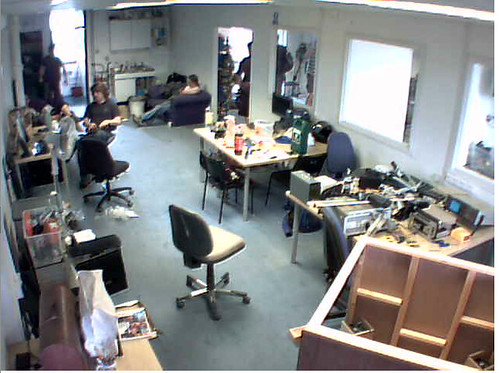
A typical dream of an active citizen scientist might be to have one’s own fully-equipment research laboratory and tinkering space conveniently established in one’s own garage or basement. Proper lab setup, either being a diy bio lab or an electronics lab or even a nuclear fusion lab, takes a great deal of planning, time, and at least some form of significant financial resource.
So, not everyone can implement personal lab spaces at home. And that is where the Hackerspace can be of assistance.
A hackerspace is a specialized open community lab where people with similar interests can meet, collaborate, experiment, and create. These are typically run as a membership organization with a board of directors and paying members, and many maintain non-profit 501(c)3 tax status. Although, Dynamic Patterns Research has not yet been directly involved with any particular hackerpace, the concept of this community format is exciting, and it is growing quickly in world-wide reach and popularity. Hackerspaces offer the essence of citizen science, and by distributing the burden of funding and management to the membership, they offer an accessible and efficient way for anyone to make their amateur research dreams come alive.
Hackerspaces.org (visit) provides an international online space for connection and collaboration between brick-and-mortar hackerspace organizations, and provides how-to documentation and support for those interested in joining existing groups or creating your own. Many of the existing hackerspaces focus on the “physical sciences”–namely, electronics, software development, and making machines that go “ping”! In a little more than one month, a San Francisco Bay-area hackerspace is attempting to gain enough funding to open a “biological” hackerspace called BioCurious. They have set up a Kickstarter project (visit) to help quickly grow interest in support, and if you live in the area you should check out the new group as they will likely provide a great, new opportunity for citizen scientists, as well as pave the way for the development of more “biohack”-spaces around the world.
For our friends in the UK, check out The Hackerspace Foundation [ VISIT ]
… …
UPDATE September 15, 2010: The BioCurious Kickstarter fundraising efforts reached its goal of $30,000 with seven days to go! Congratulations to the group, and we’ll be watching the progress.
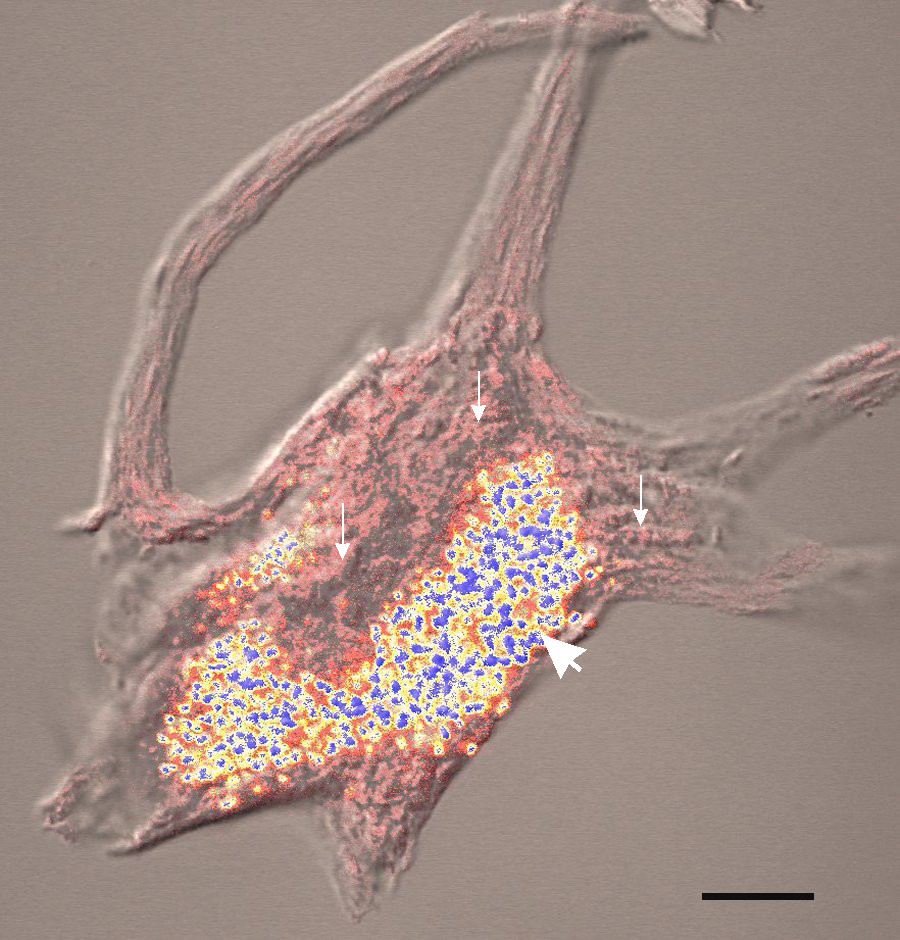
Stained motor neuron from human spinal cord; Courtesy Wikimedia Commons.
Historically, the medical approach to curing the incurable effects of tragic spinal cord injuries–such as the case made famous by America’s classic super hero, Christopher Reeve–has been to affect regeneration of damaged nerves through stem cell therapy or by introducing growth factor proteins, like BDNF. Success with these applications has yet to be realized, as apparently the adult body’s resistance to re-growing its nerve centers is stronger than expected.
Recently, however, a team at Children’s Hospital Boston lead by Zhigang He, has been developing an alternate approach to the problem. Instead of trying to force existing nerve fibers to regrow, or by introducing new cells to take their place, the group manipulates the communication in the cells to “turn off” an apparent gene that tells the neuron to stop growing. With the gene shut down, then neuron is free to generate and flourish as it sees fit.
They have found at least three proteins involved with the critical myelin coating of neuronal axons, which actively work together to inhibit myelin growth. Blocking the proteins either genetically or chemically is being shown to promote the sprouting and re-generation of local structures in neuron networks.
The process is being tested in mice with spinal cord injuries by removing a special enzyme, called PTEN, that is activated in mature systems to limit cell growth. With the enzyme out of the picture, the cells think they are young again, and start to grow. No controversial stems cells, and no introduction of unnatural chemicals… just removing a little key that is in the way. Of course, it would likely be important to be able to replace the key once the damaged cells have rejuvenated, otherwise a cancer-like state might be a drastic side effect.
Although this new therapy is not near to human trials, it is a wonderfully positive example of how significant advances in human improvement might come from looking at problems at a little different angle. These experimental mice are just paving the way for the coming acceleration into reversing such devastating human experiences that include wide-spread nervous system damage and degradation.
… …
“Mice regain movement after spinal cord injury” :: Scientific American Observations :: August 8, 2010 :: [ READ ]
“PTEN deletion enhances the regenerative ability of adult corticospinal neurons”, Kai Lui, et al., Nature Neuroscience, August 8, 2010 [ READ full article :: Download PDF ]
“Spinal cord regeneration success in mice” :: BBC News Health :: August 8, 2010 [ READ ]
Looking northeast around midnight on August 12th-13th; from NASA Science News
This week will include the peak evenings for the annual Perseid meteor shower. Although sky watchers have already seen a few exciting fireballs already, August 12 and 13 are expected to be the primary nights for viewing.
And this year, there will be an exciting pre-showing of planetary alignment in the west with Mars, Venus, and Saturn formed in a close triumvirate, and the crescent moon and Mercury a few clicks away (view a sky map). Once this special arrangement has set around 10 pm–which includes the Moon this year, so dark viewing should be optimal!–then the main attraction for the evening soon begins and will last until the Sun returns for the day.
The Perseids are pieces in the wide debris field left over from the 133-year cycle of Comet Swift-Tuttle. And, this comet is a big one, with a nucleus around 16.8 miles wide. The comet’s path follows particularly close to the Earth and Moon, and it was not long ago in 1992 that its calculated orbit was quite off from the latest observation. So far off that it was predicted that the next passage in 2126 could strike the Earth. Additional research was compiled to discover records of more ancient observations, and along with new direct observations puts the calculated orbit in safe distances for at least the next two thousand years.
On September 15 in the year 4479, humanity’s safety (or whomever or whatever is still hanging around the planet) might be more of a concern, however, as Comet Swift-Tuttle is predicted to come as close as 2.8 million miles. Certainly this moment is a way off, so hopefully we’ll have enough time to develop useful deflection technologies for such massive bodies. In the mean time, just sit back and enjoy the annual showing of Comet Swift-Tuttle bits burning up in our atmosphere.
You can track the calculated orbit of Comet Swift-Tuttle through the year 2201 with the JPL Small-Body Database Browser (launch the database of 109P/Swift-Tuttle).
… …
“Planets Align for the Perseid Meteor Shower” :: NASA Science News :: August 5, 2010 :: [ READ MORE ]
The re-emergence of the citizen scientist began a major fast forward in 1999. Scientists at the University of California Berkeley launched a new project to virtually connect millions of computers around the world to simultaneously process and evaluate radio signals from space. The gift wrapping of this program appeared to be a colorful and unique screensaver on a participant’s computer that would innocently chug along while sitting idle. The background of this program was working hard to identify subtle clues of the existence of intelligent life somewhere out in the cosmos.
SETI@Home was not the first kind of this software (a little history), but was the first popularized and most largely distributed computing application that allowed anyone with an internet connection to take part in real scientific analysis. Although over a decade later we’re still searching for life from above, the project is considered an amazing success. It technically harnessed so much computing power and processed the results in a way no other supercomputer of its time could compete with in both efficiency and–especially–cost.
Soon after the successful launch of SETI@Home, many more scientific applications were developed into the platform of distributed computing, and many more opportunities became available to the interested citizen. Evolutionary calculations, solving for drug designs to combat AIDS and cancer, analyzing data to extract the physical structure of the Milky Way, and the detection of gravitational waves all came along into the arena (and many more). In particular, an extraordinary complicated computational problem that scientists across many fields have been trying to make progress on for decades is that of protein folding; or, how does a random chain of amino acids (the building blocks of life on Earth) configure itself into complicated three-dimensional structures, the exact pattern of which determines its vital function.
The problem is one of minimization of energy where every given chain naturally falls into a coiled state that happens to require the least amount of energy to sit in that state. Consider how much energy it takes to play the game Twister, how much more energy it takes to win at Twister. Now, consider how much energy it takes to sit on the couch with your arms at your sides watching a favorite movie. Couch potato might be your personal configuration of a minimum energy state, while your contortions during Twister require uncomfortably high energy.
Nature seems to figure this problem out because it can’t do it any other way–if the protein “feels” too kinked up then it just flips into something more comfortable. But, human beings who want to understand the physics of this process are having a difficult time coming up with a clean mathematical representation of the experience of the protein. Computers–and their mighty brute force–are used to take a chain and calculate the energy required to maintain every possible configuration of the protein with the hope to then look back at all of the results of calculated energies and see which one has the smallest value. A rather straightforward approach, but the statistical possibilities for longer and longer chains become immense.
So, here is where human intuition has been coming into play. More recently, the protein folding team decided to integrate the power of the human mind into the calculation process. They developed a game system (visit Foldit) that allowed players–the citizen scientists–to gaze at a potential configuration of a protein. The edges requiring higher energies are highlighted and they can then “play” with the configuration interactively. With each tweak of the structure, the energies would be recalculated and displayed, and the human being could feel their way to a structure that seemed to carry the least energy. Sort of how nature might do it, too… without the obvious conscious observer, but rather in a more self-organized fashion.
The results of the game can actually be tested, as likely structures identified by the citizen scientists and recognized by the professional scientists can then be generated in the laboratory and monitored to see how stable the folded pattern actual is for that protein. In fact, the first academic paper has just been published, and the author list includes some of the actual citizen scientist players of Foldit.
“Citizen science: People power” :: Nature News :: August 4, 2010
So, it’s this “people power” through distributed thinking that is bringing new success to the critically important and painfully difficult computational problem of protein folding. Similar results are also being experienced by GalaxyZoo and their expanding platform of Zooninverse, where nearly 312,000 at home users help identify interesting astronomical structures or phenomena that require subjective classification decisions. The possibilities in these classifications are nearly endless, and programming an endless list of options into computer code is maybe not the most effective use of a computer scientist’s time.
Identification of phenomena in our amazing universe by coding is just not as effective as the slick, and subconscious intuition of the alert human brain. This is a unique skill that neuroscientists don’t even remotely understand, and it is certainly a skill obviously lacking in all computers. And, it is citizen scientists who are using their unique skill to actually drive computational research and development. These efforts will help scientists better understand what results intuition can bring, and possibly how to develop computational platforms to perform in similar ways.
Maybe then, citizen science will help bring us even closer to the inevitable Singularity Event (learn more about it), predicted to occur around 2050. It is this future time when the accelerating advances in computational power will surpass that of the human brain, and things will change dramatically. Computers will gain that unique, once human-only characteristic and will then continue–on their own–to further accelerate their own technology beyond that of human engineering. The final transitional technology that directs us to The Singularity will be the final invention of our species, and from that point on we will be connected in with a powerful force that will continue our evolutionary process at an incredibly high rate.
Maybe the further development of “distributed thinking” during the 2010’s will be the key technology for The Singularity to occur. Maybe citizen scientists around the world will play the critical role in the development of this technology. A fitting connection, of course, because it would represent the ultimate final experience of the evolutionary advantage that the homo sapiens hold over all other existing species; that of invention. As a massive collective effort, our species will together participate in an evolutionary development that will lead to a fundamentally new era in life on Earth. We will as citizen scientists work together to create and invent the next step in our own evolution, and with this will bring about the next version of the humanoid, Human 2.0.
Last year, Popular Mechanics featured a great “TOP SEVEN” List of most influential amateur researchers today. The recommendations were provided by Dr. Shawn Carlson, a former Scientific American columnist and the executive director of the Society for Amateur Scientists.
From retired computer programmers to high school educators, the list includes an exciting representation of very real science and engineering that is being accomplished by non-professionals without major funding. There are, of course, thousands of amateur scientists and programs out in the world today–and DPR is working to feature as many as possible–but, this is an inspiring group that should get your citizen science brain electrified.
What so you think of these featured projects? And, what do you think is needed to bring these and other serious amateur work back into the top-of-mind consciousness of the greater scientific community?
… …
“Inside Amateur Science: The Best in Out-of-Lab Research” :: Popular Mechanics :: June 11, 2009 [ READ THE LIST ]
Back in the day, families in general seemed to do most of the work needed for themselves by themselves, since this was really required if a family was to simply survive the day. Over the past 100 years, the reliance on professionalism across the globe has steadily increased. The advantages to this “outsourcing of life’s primary needs” approach are endless… we have professional farmers that allow our refrigerators to be full with only a trip to the grocery store; we have professional protectors who work efficiently at keeping dangers as far away from our doorstep as possible without us even being aware of those dangers.
There is an already growing popularity of amateur research efforts in astronomy and environmental sciences, and how well they support current professional scientists is becoming more appreciated. David Brin, science fiction author and futurist, discusses how the effectiveness of the amateur is coming back into trend, and even the US Department of Defense is beginning to realize the potential power of millions of citizens with their on-the-spot observational abilities connected with their high-performing computers and imaging devices in their pockets (a.k.a. cell phones) (read more).
Mr. Brin predicts a turning-the-tide of sorts between the professional and amateur, where the deluge of professionals in this world is causing a plateau in progress as there are just so many people who can actually get a job being a professional… should everyone in the neighborhood really try to become a Ph.D. physicist to profess at the local university? The exponential increase in information and scientific data to be processed by the professionals is driving the need for the masses and their interest in science. And, with this growing citizen science interest, the amateur movement will likely become a critical component in the successful advancements in new scientific understanding in the future.
Do you think the role of the amateur will be so important, or should science-at-home be left to the realms of educating our kids and the happy hobbyist?