On the eve of Thanksgiving, we tend to start our annual pondering about how we might give more to our friends and family, and maybe even to the world. Citizen scientists–whether they consciously realize it or not–are behaving in a uniquely giving mood with every bird they count, PC time they donate, comet they spot, or galaxy structure they visually identify (among so many more important activities!). The efforts of citizen scientists are a pure form of generosity through the free distribution of knowledge.
Scientific advancement through the professional academic universe certainly has developed an entrenched hierarchy of those who know the “truth,” those who are learning the “truth,” and … everyone else. Having personally experienced the educational opportunities inside advanced scientific learning, it would seem nearly impossible or impractical for an at-home, informal learner of any age to tap into meaningful research or scientific discovery. The notion of the average citizen directly contributing to actual scientific advancement would seem counter intuitive–to the professional academic community.
But, with the advancement of communication technologies in the 21st Century, from Internet technologies to hand-held computing devices, the power of real scientific participation is being delegated to the masses. And, the masses are taking part. Profoundly, they are volunteering their time, skills, and general enthusiasm to explore nature and the universe to not only help with the advancement of scientific understanding, but to increase their personal appreciation for that elusive “truth.”
Roger Highfield, former Telegraph science editor and current editor of New Scientist, recently realized this profound volunteer effort of the crowd and how their contributions have been dramatically influencing scientific advancements, and will certainly continue to do so.
… …
“Crowdsourcing and open source: knowledge is a gift” :: The Telegraph by Roger Highfield :: November 23, 2010 :: [ READ ]
Earlier this month the National Oceanic and Atmospheric Administration (NOAA) announced that $8 million worth of new grant money has been awarded to educational and non-profit institutions across the United States to support programs that connect the public to science appreciation and interactivity.
The NOAA’s Environmental Literacy Grant program focuses to enhance informal educational opportunities at museums and through family and teen programs, as well as expand citizen science networks. The funded projects will work to increase the understanding and appreciation of environmental issues of the oceans, coastlines, Great Lakes, and the climate around the globe.
Thirteen projects across the United States were selected to be funded from a national competition. The largest funding amount–$1.25 million–was given to Colorado State University’s “CoCoRaHS” project (or, the Capitalizing on Technological Advancements to Expand Environmental Literacy through a successful Citizen Science Network; Read More). This program brings together volunteers to take direct measurements of precipitation quantity, intensity, duration and patterns, all from their own backyards. To take part in the project, visit the program online to learn more (visit CoCoRaHS).
This year’s funding round from the NOAA is so significant because it continues to legitimize the efforts of citizen science and the critical influence of informal education in our culture. Much can be learned in the classroom, but so much more can be experienced with science education and appreciation at home, with friends and family, and with national and international connections and networks of other active amateur scientists.
The NOAA, a federal agency, is providing real money to support these programs as its administration understands the importance of fostering increased scientific awareness across our cultures. Through this funding, NOAA also appreciates that not only can these sorts of citizen science programs heighten a broader population’s appreciation of our world, but their collective scientific efforts from the masses can provide critical research data that will help professional scientists better understand the universe–from our backyard all the way out into the cosmos–in ways that the professionals cannot manage on their own.
A complete list of awards has been included below, courtesy of the NOAA press release. Take a close look at all of the exciting programs, and explore which opportunity you might be able to take part. If you have had any experiences with any of these programs, or are planning on taking part in any way, please report and share with us here on Dynamic Patterns Research.
… …
“NOAA Announces Environmental Literacy Grants for Science Education” :: NOAA’s Office of Education Press Release :: November 2, 2010 :: [ READ ]
Colorado State University; “CoCoRaHS: Capitalizing on Technological Advancements to Expand Environmental Literacy through a successful Citizen Science Network”; $1,249,993
College of Exploration (Va.), Literacy Volunteers of America (Fla.); “A collaborative project: Engaging ESL adult and youth learners in technologically facilitated outdoor experiential learning to improve environmental, ocean, climate and English literacy”; $400,000
Seacoast Science Center (N.H.); “Families by the Seaside: Building community-based outdoor ocean science learning experiences”; $489,574
Science Museum of Virginia; “Science on a Sphere–Earth Systems Display Center at Science Museum of Virginia”; $295,202
Butler University (Ind.); “FLOW: an innovative educational toolkit for river awareness”; $257,492
Exploratorium (Calif.); “Embedding NOAA in a Public Learning Laboratory – The Environmental Scientist-In-Residence Program at the Exploratorium”; $517,900
Update, December 3, 2010: NOAA published a more detailed overview of each project funded [ VIEW ]
Although it’s getting a little chilly outside for the citizen scientists in the Northern Hemisphere, there are always plenty of astounding stars and planets to view in the dark of night. Jupiter is glowing brightly, and is sitting very near the Moon right now at the middle of the month. The Leonid Meteor Shower will peak on November 17 (read more), which is all thanks to debris that fell from Comet Tempel-Tuttle.
To plan your November nighttime viewing, download this month’s Sky Map, courtesy of SkyMaps.com. Whether you are looking with your eyes, binoculars, or a telescope, let us know what you find particular interesting and beautiful this month!
Cornell University’s Lab of Ornithology has just begun its 24th year of Project FeederWatch. This annual winter citizen science program asks participants to maintain bird feeders in a clearly defined observational area, like your backyard view from the kitchen window, and count maximum numbers of identifiable birds on selected observation days.
The observational period runs from November 13 through April 8, and anyone may still register to get involved in the 2010-2011 season. Registration may be quickly completed online and costs $15. With this fee, you will receive an observational kit including a bird-identification poster, bird-feeding information, and instructional materials.
The data collected from participating citizen scientists is extremely valuable for monitoring the distribution of winter birds all over North America. And, because the program requests reporting to be completed every week, if possible, a very detailed and dynamic view of bird populations can be developed during the observational period.
The FeederWatch project is a perfect opportunity for anyone who is a casual backyard bird watcher to take only a small step to observing birds at the next level. The information provided to the Lab or Ornithology will be used by engaged researchers who are dedicated to monitoring and protecting our avian friends.
This program also offers a great educational experience for families to enjoy together at home. Through making observational identifications (which is made much easier with the provided poster and additional online resources–see All About Birds), recording and submitting data, and reviewing and exploring current data online, young learners will have a self-guided experience to develop critical skills along with a new appreciation for nature and the scientific process.
Dynamic Patterns Research has just registered with Project FeederWatch, so we will be participating in the current season. After our first observational days and reporting has been completed, we will post our results and experience here on DPR.
If you are also participating, please let us know by commenting below or contact us. We would like to share your observations with brief summaries here on Dynamic Patterns Research to report on active citizen scientists and their efforts and experiences.
Last year, DPR AmSci Journal wrote about a great new citizen science program called Citizen Sky [read from August 26, 2009]. This project is collecting observational data on the current eclipsing of the variable binary star system epsilon Aurigae. The primary star is estimated to be 300 times the diameter of our Sun, and the eclipsing object orbits at about the equivalent distance of Neptune from the Sun.
Eclipse durations measurements of epsilon Aurigae. Courtesy CitizenSky.org.
Discovered in 1821 by Johann Fritsch, the system has continued to be a mystery with its odd 27-year eclipsing cycle coupled with a 600+ day eclipse, which has been increasing in length during each cycle.
The most recent plausible hypothesis to describe this interaction was proposed in 1965, which suggests that an edge-on disk, possibly surrounding another star or planet, is orbiting the giant star. This idea was just recently confirmed with the direct observation of the current eclipse from an international team lead by Brian Kloppenborg at the University of Denver, and joined by groups from the University of St Andrews, Georgia State, and the University of Michigan.
Combining the images from four separate telescopes, this innovative method uses optical interferometry to generate a spectacular view of the eclipse estimated to be 140 times sharper than what the Hubble Space Telescope could generate.
CHARA-MIRC Image of Eclipsing epsilon Aurigae. Courtesy University of Michigan Astronomy
The eclipse began in August 2009, and will be in its dim minimum throughout 2010 until returning to normal brightness in the summer of 2011. Over one thousand citizen scientists have been participating and more are still being requested to help collect as much data as possible over the next year.
With all of the participants in this science program, and the hundreds of thousands of citizens working with the ever-growing collection of real science opportunities for the public, it is interesting to start considering how this participation actually influences the individual volunteers.
Graduate student and staff member at the American Association of Variable Star Observers (AAVSO), Aaron Price, has been developing his thesis in science education at Tufts University to begin exploring this important connection between science literacy and the volunteer citizen scientists. Using a series of pre- and post-surveys administered to actual users of the Citizen Sky project, Mr. Price develops quantitative reviews of how some aspects of scientific literacy can be impacted by direct participation in collaborative citizen science programs.
This type of research should become an important building block for the continued success and development of future citizen science programs. By learning to focus in on how to best connect a broader population into an increased level of general scientific understanding and appreciation will not only allow for scientific advances to progress more efficiently, but the participating cultures will benefit as a whole with more sophisticated ways of living.
You may watch Mr. Price’s dissertation defense live, and even participate yourself with questions, on November 1, 2010. With this streaming event, we should participate as active citizen scientists to help guide the professional scientific community in the underlying understanding of how these projects connect with the participants so that future citizen science projects may be improved and developed with new education innovations.
WATCH LIVE “Scientific Literacy of Adult Participants in an Online Citizen Science Project” Time: Monday, November 1, 2010 at 4:30pm (EST)
If you do watch the defense and participate, please comment below or on the DPR Facebook page to tell us what you thought of the discussion. How do you feel your personal scientific literacy has changed since participating in citizen science programs? Do you think that these projects are valuable methods for expanding the general public’s appreciation for scientific understanding?
… …
“Online streaming of dissertation defense about Citizen Sky” :: blog posting by Aaron Price :: October 22, 2010 :: [ READ ]
Learn more about the Citizen Sky project and register to prepare to submit your own observations of epsilon Aurigae. There is still plenty of time to participate as the 600-plus-day long eclipse in only half-way complete.
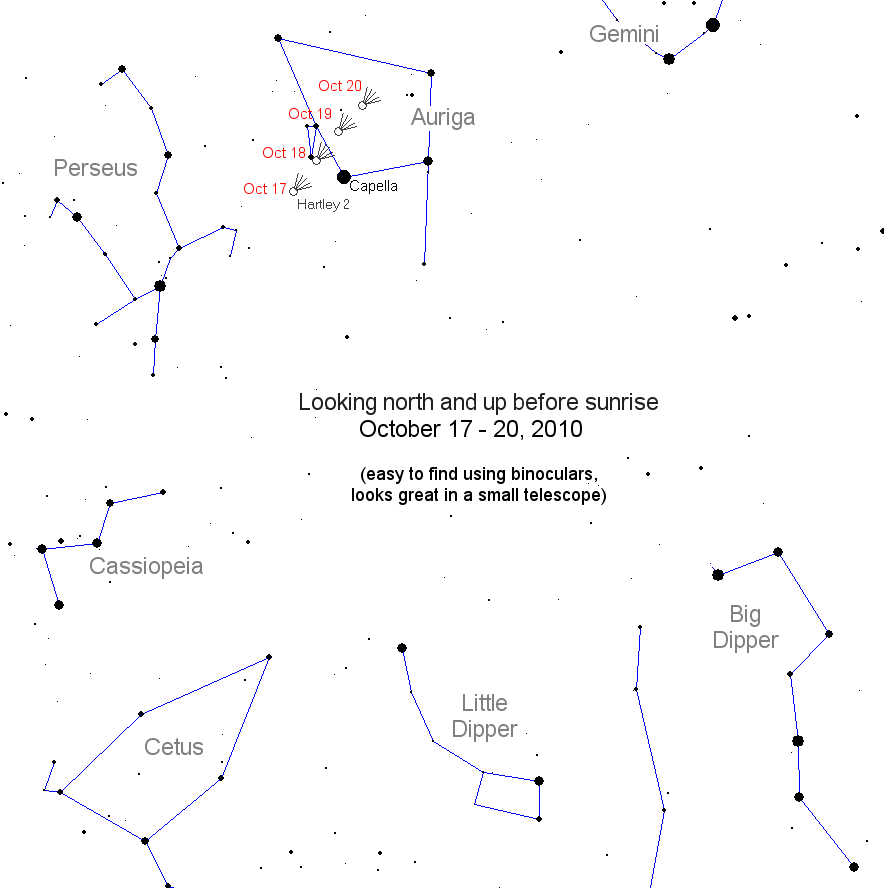
Skimming by Earth as close as 11 million miles on October 20, the apparently young Hartley 2 comet will be nearly visible to the unaided eye. With binoculars, it will appear even better as a fuzzy, green blob, and a backyard telescope will offer excellent viewing. The next several days should be busy mornings for amateur astronomers, and will also be a great time for anyone to do some easy viewing of a special celestial event.
Head outside while it is still dark before sunrise, and look upward to the north. Passing through the constellation Auriga will be an unusual green blip from October 17 through October 20. If you are skilled in taking photographs… or, just want to give it a try!… please post your images on our Facebook page and tell us about how you took the image and what equipment you used. We are very interested to see the results from experienced amateurs as well as first-time astro-photographers.
Sky map for Comet 103P/Hartley 2 on October 17 through 20. Courtesy Spaceweather.com
Discovered in 1986 by Malcolm Hartley, Comet 103P/Hartley 2 orbits the Sun about every 6 1/2 years. Based on current estimates of mass loss, it’s expected to last for another 700 years. [ READ MORE ] What’s particularly interesting about this comet is that it is relatively small–just less than a mile in diameter–but the nucleus is still very active. On November 4, 2010, NASA’s Deep Impact/EPOXI spacecraft will venture only 435 miles away from the comet to frantically take images and data about the unique comet. At this point in the comet’s orbit, it will be about at its closest approach to the Sun, called the perihelion distance, and the ice formed during it’s long journey in the outer solar system will be vaporizing at rates that are much higher than other previously observed comets. EPOXI will be close enough to take stunning images of out-gassing, and it will potentially observe physical features directly on the surface of the nucleus at a resolution of 7 meters per pixel.
Orbit Diagram of Comet 103P/Hartley 2 generated from NASA's JPL Small-Body Database Browser.
This study is so important because Hartley 2 will be only the fifth comet nucleus viewed up close and personal by NASA. And, comets are critically important because they represent untouched remnants from the formation of our solar system. These chunks of pre-system debris did not get sucked into a forming planet long ago, so they contain material that was present way before even the Earth started preparing itself for the development of life.
Be sure to learn more about this exciting Comet 103P/Hartley 2 and how NASA is preparing to study the orbiting body [ READ MORE ]. Take the time this week to head out in the early morning and look up for the green, glowing blob that might prove to be a treasure trove of new scientific understanding.