2011

Witness the Flyby of an Asteroid a Quarter of a Mile Wide

On November 8, 2011 in the late afternoon (CST), a rather large space rock will fly within about 200,000 miles of our home. There is no chance that it will impact this time around, and has very minimal chances for the next several hundred years.

View the interactive orbit diagram for 2005 YU55 from NASA’s JPL.

This certainly isn’t the first time large asteroids have whizzed by Planet Earth, but what is exciting is that astronomers for the first time have had a reasonable head’s up to look for such a large object so close before the flyby. This might be a little disturbing, of course, as this “first” does represent a significant weakness in our past successes of identifying potentially dangerous near-Earth objects. And, Dynamic Patterns Research has written about this important issue earlier this year, with a focus on how amateur researchers can play an important role in early detection.

The path of the asteroid will take about 11 hours to pass through Earth’s field-of-view, and amateur astronomers in North America should be able to glimpse 2005 YU55 with nice backyard telescopes. A detailed path was generated courtesy of Sky and Telescope (VIEW MAP) and you may read more about the flyby along with additional observational tips:

“Mini-Asteroid Makes a House Call”, HOMEPAGE OBSERVING by Kelly Beatty
Sky and Telescope November 1, 2011. [ READ ]

Watch how NASA is planning track the close approach of 2005 YU55:

Witness the Flyby of an Asteroid a Quarter of a Mile Wide Read More »
Citizen Scientists Discover Two Exoplanets

The Planet Hunters team from Zooniverse — which includes citizen scientist volunteers from all over the world — has submitted their first journal paper for peer review and possible publication announcing two confirmed planets outside our familiar solar system.

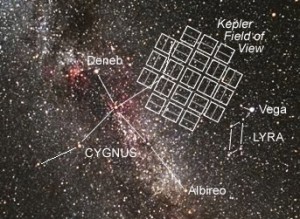
Using public light curve data generated from NASA’s Kepler Space Telescope, a mass of citizen scientists sortedNASA's Kepler Field of View through and visually evaluated a mountain of data points identifying possible signals of planets crossing the paths of stars in a tiny corner of the Universe. The ten best candidates from the first batch of data was submitted to other ground-based telescopes for further observations. Two of the ten candidates have been re-observed and confirmed by the W.M. Keck Observatory in Hawaii, which firmly demonstrates the true power of how citizen scientists can be involved in serious scientific advancement.

The two identified exoplanets are both much larger than Earth with diameters of about 21,000 miles and 64,000 miles across (our small Earth is only about 8,000 miles wide), and have very tight orbits around their stars at about 10 days and 50 days, respectively. The light curve data for these two stars, SPH 10125117 and SPH 10100751, may be viewed through the Planet Hunters interface, and you may try out your own analysis to find the tell-tale signature of planets passing through the observational plane of its host star.

The complete paper submitted by Planet Hunters may be read online through the arXiv.org database or downloaded directly as a PDF document: Planet Hunters: The First Two Planet Candidates Identified by the Public using the Kepler Public Archive Data.

You may also learn more about the Planet Hunters program and a more detailed review of planet hunting techniques from Dynamic Patterns Research. Please let us know if you have been participating in the Planet Hunting program, or if you have any questions about getting involved now. The importance of discovering planets outside our solar system will certainly prove to be critical to our great++ grandchildren and we, as active citizen scientists, can be a valuable resource toward making these scientific efforts more cost effective, efficient, and accurate.

Citizen Scientists Discover Two Exoplanets Read More »

Design Your Own Zooniverse Project

The extreme popularity and continuing scientific success of Galaxy Zoo and the subsequent explosion of the many Zooniverse projects have brought useful and important scientific research to the masses of interested citizens from around the world. Dynamic Patterns Research continues to support these awesome efforts, and is currently actively involved in the Planet Hunters program. Zooniverse has been adding new projects at an impressive rate–there are ten live projects now–and they apparently have no plans to slow down. In fact, they are now looking outward to the very group of people who processes their masses of data to brainstorm the next big citizen science project to be developed.

Citizen Science Alliance

Hosted through the Citizen Science Alliance and with support from the Alfred P. Sloan Foundation and the Adler Planetarium, Zooniverse has announced an open call for proposals for future scientific projects that would benefit from the collective, analytical efforts of hundreds of thousands of remote volunteers. The proposals would need to have a direct connection with a scientific or research group, but the ideas should also be able to flow from citizen scientists themselves.

The next selection round of ideas will occur in January 2012, so plan on completing your submission in December 2011. If you are not familiar with the great Zooniverse projects, take some time to directly experience how powerful they are and the potential that the platform can have for so many other serious scientific questions that can only be successfully answered with the critical help from citizen scientists around the world.

Begin Your Submission

Design Your Own Zooniverse Project Read More »

fEITER image of an anaesthetised brain.

A Live View of Unconsciousness

It’s difficult to know what you are thinking — or what is happening in your own brain — as you loose consciousness. There are many instances where this loss might happen, including getting whacked up side the head, inhaling a large volume of non-medically-inspired drugs, or, to the preference of many, falling into a deep sleep during anesthesia before an invasive operation.

Many research groups have studied the brain during its influence to anesthetic drugs, in particular Stuart Hameroff from the University of Arizona. The brain seems to become almost numb and nearly shuts down entirely, enabling trained professionals to freely cut into the human body without the distraction of painful screams and cries for help from the patient. But, this is a rather interesting phenomena, that is not entirely understood.

fEITER image of an anaesthetised brain.
Reconstruction of the brain during the onset of anaesthesia. CREDIT: University of Manchester via LiveScience.com

Directly watching the brain as it slips into unconsciousness would certainly be an interesting approach to trying to solve not only the mysteries of anesthesia, but to also better understand what it means for the brain to be conscious, or at least aware. Now, with a new observational technique developed by the University of Manchester, called functional electrical impedance tomography by evoked response (fEITER), the attempt is underway to create live views of the brain’s electrical activity as it shuts down from anesthetic drugs. With this near real-time recording, the research team, lead by Brian Pollard, Professor of Anaesthesia at the University of Manchester, is hoping to learn more about the differences between an unaware and aware brain and how these differences might lead to a better understanding of what the phenomenon of consciousness really is for human beings.

Notice, here, that a subtle change of words was made from “consciousness” to “awareness” and back again. This difference seems to be important, however, and should not be used lightly. A brain might be considered “aware” of its surroundings by responding to pain being induced on its body, or to the intense colors and lights surrounding its head during a walk through Times Square in New York City. But, a simple diode light sensor switching off an automatic garage door motor might also be considered to be “aware” of the puppy dog running through its beam just before the door touches ground.

So, what seems to be an additional specialty to humans is that our brains are more than just aware. There is something more to consciousness; something to being self-aware. Or, maybe not… we just don’t understand, yet. However, the real-time, three-dimensional electrical views generated by fEITER devices should provide some extremely interesting comparisons between the aware and unaware brain. And, it is seemingly from this awareness that emerges our sensation of consciousness, so understanding the electrical requirements for awareness is an important step to understanding the neural correlate of consciousness.

“3-D Images Reveal What Happens as Brain Loses Consciousness” :: LiveScience :: June 10, 2011 [ READ ]

A Live View of Unconsciousness Read More »

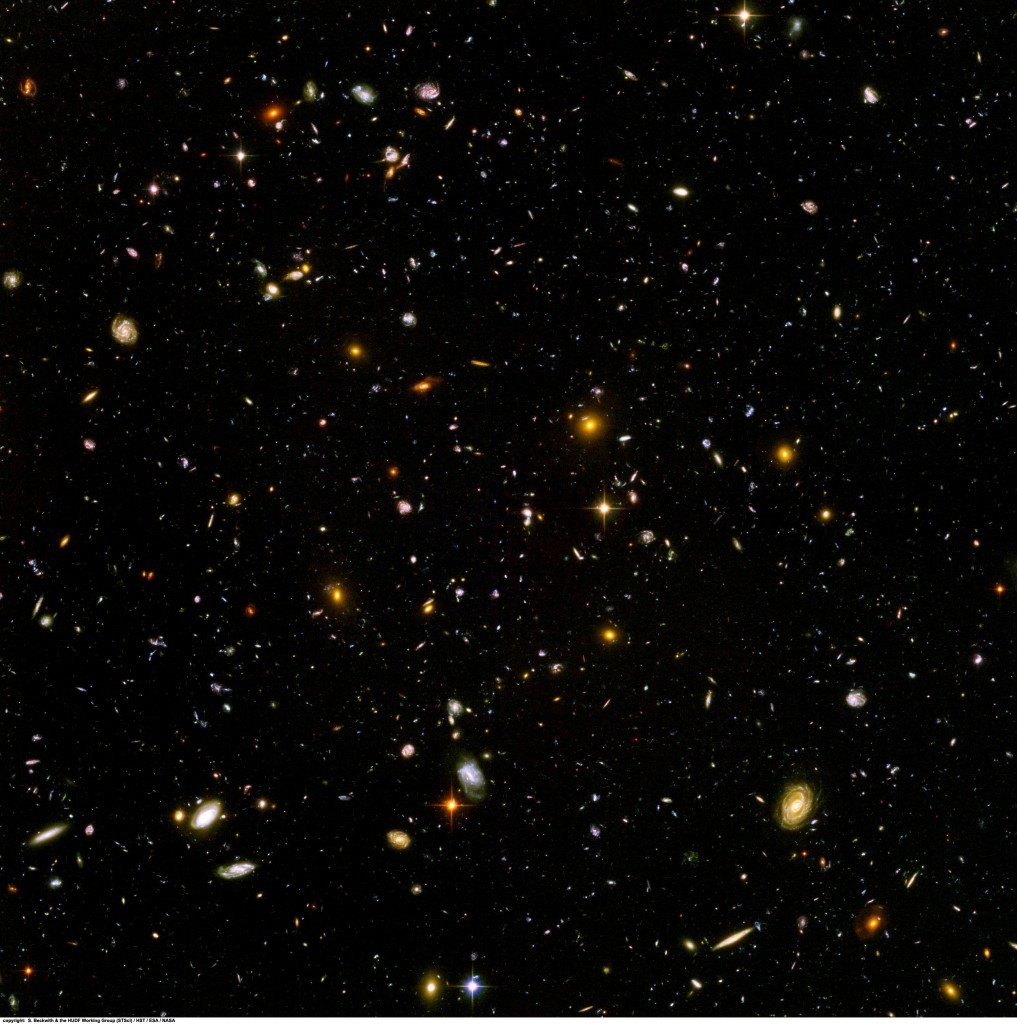
From here to infinity, Mothers create the most amazing things in the Universe.

The HUDF includes galaxies of various ages, sizes, shapes, and colors. The smallest, reddest galaxies, are some of the most distant galaxies to have been imaged by an optical telescope, existing at the time shortly after the Big Bang.

The Hubble Ultra Deep field image, taken in 2003, is considered to be the most amazing image ever created by human beings. A direct view of the Universe 13 billion years ago, it contains over 10,000 galaxies, each of which can contain 100 billion stars, or even more.

The enormity of what this image represents is so awesome and so amazing, it’s really impossible for any one human being to comprehend not only its meaning, but that it can actually be.

And, although this image represents something so spectacular, there is still another image closer to home that is infinitely more special to me, as a husband and father. This might be because it is actually possible to comprehend its meaning, it is possible to understand that it is real, and it is felt deep within my heart that it is the most important and wonderful thing that exists in the Universe.

My two children, now five and two years old, are amazing, and it is simply incredible that they exist. There is almost nothing more exciting and wonderful than the fact that these two children were created and will grow up to be fabulous human beings.

My sense of wonder and awe is amplified because of my many previous experiences with wonder and awe while I’ve spent many years of my life learning about how the Universe works, experimenting in that Universe, and trying to express these exciting understandings to others. As a citizen scientist who thoroughly enjoys a continuous advancement of ones own appreciation and understanding of Nature, it is all that more satisfying to be able to share this appreciation with ones own children.


Sister and Brother, the Princess and Prince.

But, what is even more amazing than my children is that my wife, Michelle, created them. What she went through to nurture these babies and bring them both into the world was absolutely insane. And, this is what makes her so incredible. This is what makes all mothers quite incredible. I think that my wife is so amazing for having created our children and this is one reason why I love her more than anything else. It really was an outstanding feat, and only she could have done it: no one else in this infinite Universe could have created exactly our children. They would never have come to be without my wife, and their entire lives and our lives together as a family could have never existed with her.


There is no other image ever created in all of human history that is more important to me than an image of our children. And, my wife is the one who made that all possible. No one else could have done this amazing thing for me, and that makes her such an absolutely incredible person.

With much love on Mother’s Day.
Matthew T. Dearing

From here to infinity, Mothers create the most amazing things in the Universe. Read More »

Citizen Scientists to Map Biogeography of Microorganisms Across United States

The Astrobiology Research Center at Penn State is currently developing a pilot citizen science program to study the diversity of microbes that live in your home hot water heater. The goal of this initial project is to test their approach for bridging citizen scientists volunteers with microbiology, as well as to create an initial “map” of the diversity of microorganisms across the United States.

The research group is looking for only two volunteers from each state at this time. If you would like to participate, simply register online.

View the Project Flyer (pdf)

Citizen Scientists to Map Biogeography of Microorganisms Across United States Read More »

Last updated June 20, 2022