2009

Count Stars from your Backyard for Science

The 2009 Great World Wide Star Count is already under way, and there is still time to wait for a perfectly pleasant fall evening to step outside and count the stars. Through October 23, this annual citizen science event from Windows to the Universe of the University Corporation for Atmospheric Research (UCAR) will be accepting online data collection from amateurs around the world.

Using observational techniques first developed by the Greek astronomer, Hipparchus (learn more about astronomer’s magnitude scale), participants are asked to view a particular constellation–depending on your location–and estimate how many stars you can see. Based on your observations, you then make a decision, with great guidance from the activity guide, on the “Limiting Magnitude” of your night sky, which measures the faintest stars you can see.

A step-by-step activity guide is available (in eight different languages) to help make the experience easy and fun for anyone to do. Not only will this data from citizen scientists provide astronomers with important information about light pollution and other visibility issues (view the results from 2008), but it is a great opportunity for families to pique the interest of children (and interested adults!) into an appreciation for the amazing universe in which we live.

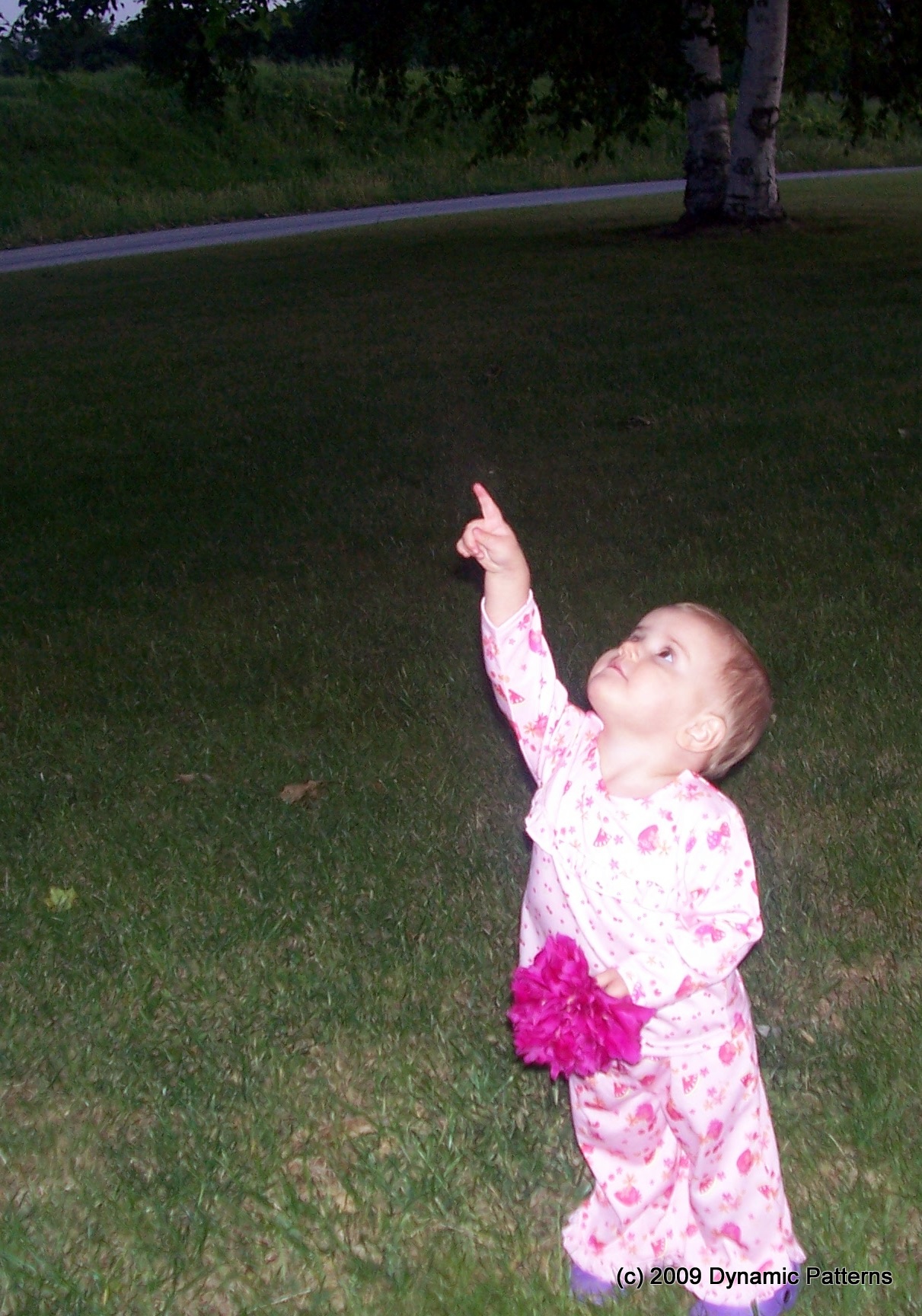
IMG_1468.JPGLast evening, I participated in the Great World Wide Star Count with my 3 1/2-year old daughter, and it was a great first introduction to constellations and just looking up. We have already attended a local star party where she was able to look through telescopes to view the Moon and Jupiter, but this project offered just another little step toward thinking more about the thousands of points of light she sees every night.

IMG_1474.JPGWe first talked a bit about how people have found patterns up in the sky, a lot like we find patterns in clouds, and went through the easy and fun tutorial on the website to help us find Cygnus, our viewing constellation. We then reviewed the activity guide’s clear illustrations to prepare us to think about how we are going to make our decision as to what our night sky’s limiting magnitude might be.

So, with just a few fun minutes of thinking about what we are about to see… and a little playing on the computer with the constellation finding tutorial (view)… we bundled up in our jacket and headed outside to spend a little quality time just looking up.

After the viewing, we came back inside, reviewed again the activity guide’s illustrations on what our night sky looked like, and together we agreed on a decision of our observed limiting magnitude. Finally, we went back to the reporting website, entered in our Latitude and Longitude and recorded our observation. Our data immediately appeared on the featured map, and it was cool to see our point with the hundreds of others from around the world.

There are only a few days left, so go outside and count the stars in your night sky tonight with the Great World Wide Star Count!
The Great World Wide Star Count :: [ PARTICIPATE NOW ]

Count Stars from your Backyard for Science Read More »

European Amateur Science Society Makes Major Dinosaur Discovery

For several years, a European amateur science group was on the trail of dinosaur prints and last spring they made a significant discovery. Now authenticated by scientists at Lyon University and France’s National Center for Scientific Research, the find is one of the largest and most well preserved prints from a sauropod estimated to be 150 million years old.

What’s particularly exciting about this finding–in addition to the pure excitement from being able to directly witness the movements of our planet’s once great giants–is that the possibility of important scientific progress coming from groups of amateurs and citizen scientists is so great. More organized citizen scientist groups must be developed around the world, and with this growth not only will scientific progress benefit, but the increased appreciation and understanding of science will begin to reach an even broader population.

For example, in the United States, the Society of Amateur Scientists is a national organization that will support the development of local and regional chapters, which is the absolute perfect opportunity for interested people to self-organize and generate some real science and generate some real science appreciation for the masses. Their current list of active local chapters is rather limited, but the time is ripe for growing local interest and regional society groups to become deeply involved in citizen science around the country.

In particular, this author is working on establishing a local chapter for the Central Illinois region, so if you are located in the area and would be interested in considering being a charter member of a new local chapter, please let me know.

Be inspired by the increasing number of successes of important results from citizen scientists and get more involved to see what wonderful science you may discover and experience.

“”Unique” dinosaur footprints discovered in France” :: Reuters / AP :: October 6, 2009 :: [ READ ]

European Amateur Science Society Makes Major Dinosaur Discovery Read More »

Encouraging Science with our Children

So much science education happens in informal ways–outside of the classroom. These experiences can be so valuable and sometimes even more influential than the classic approaches taken for so long by the public school system of the American culture.

Successful informal educational opportunities can start right at home between parents and their children at the earliest ages. From simple questions to make a child think about what is happening around us to getting directly involved with exciting citizen science projects in our community, there are so many opportunities that can be presented to a young mind that can leave a lasting impression.

A growing focus on the importance of informal education is emerging, and citizen scientists can be on the forefront of this valuable movement. The National Academies Press has published materials on the issue, and is helping to create new studies and information on how informal educational approaches might be more thoroughly developed.

In their latest newsletter (subscribe), NAC featured an interesting survey of readers who had experiences as a child of a lasting memory of an informal educational experience. The following are some of their favorite responses…

“‘My dad waking us all up at 2 a.m. on a freezing winter night to come out and see the Northern Lights; I was 4 years old and never forgot.’

‘Studying pond water samples with a friend’s microscope, drawing my observations, then going to the library to find the names of the microbes (amoeba, diatoms, etc.) during the summer between 3rd and 4th grade.’

‘Making an electromagnet out of a piece of wire, a nail, and a battery.’

‘The original Mr. Wizard television program set my future path toward science. Each episode presented scientific concepts through interesting and understandable demonstrations that, for the most part, the young viewer was encouraged to try at home. This was really exciting TV!’

‘The first time I learned to mix baking soda and vinegar to make carbon dioxide and the resulting foam overflowed on to my parent’s kitchen table.’

‘A lifetime of interest came from my father’s simple question: ‘Why is it so hard to push this boat into the water?’ 40 years later, I am still pursuing wave flows and resistance.’

‘Sitting on the front porch with my father and siblings counting the seconds between the lightning flash and the thunder that followed. We estimated how far away the lightning strike was and learned math as well as science.'”

Each of these special memories should be an inspiration for parents and how we can contribute to positive informal science education every day. If you and your children have experienced meaningful informal science education moments–no matter how small–please tell us about it by posting a comment here on DPR AmSci Journal.

Learn more about The National Academies Press [ VISIT ] and the National Academy of Sciences [ VISIT ]

Encouraging Science with our Children Read More »

The New Make: Science Room for At Home Amateur Research

The ultimate do-it-yourself and hack-your-way-to-happiness magazine, MAKE, recently launched a new section to their Make:Online website just for supporting the at home citizen scientist.

Having just subscribed to the online version of the magazine, I am excited to see the additional resources that Make is developing to actually support the education of amateur scientists with this guide for entering into the world of science at home. The focus at this time is on at home chemistry projects, and will help you take your old children’s chemistry set experience to the next level in your garage (or basement, or laundry room).

Even if you are not particularly interested in doing chemistry at home–and bringing in the possibility of causing glass beakers go “Bang!”–the online resource will still provide a valuable educational experience to help you think about the process of setting up an at home lab–for any project–and what all should be considered in the process.

If you have setup your own at home lab, or are planning on venturing into this exciting opportunity of at home science labs, then tell us about your experiences here on DPR AmSci Journal!

Make: Science Room [ VISIT ]

The New Make: Science Room for At Home Amateur Research Read More »

Conscious Learning in the Unconscious

Sitting at the bed side of a loved one who has slipped into a coma and simply reading a story, talking about the day, or just holding hands most likely feels like a pointless and endless effort for the recovery of the vegetative patient. There can only be the glimmer of hope that maybe they can sense your presence, but there is no definitive way to know for sure if your interactions are falling on a deaf brain.

We all can make personal judgments that we are conscious right here and right now. But, making this sort of judgment for another individual when their interactions with the world are limited or apparently absent is not only challenging, but also ethically dangerous as your decision can mean life or death. But now, a new, low-cost study on the interactions of patients who are considered to be in a “minimally conscious state” (MCS) is showing a very exciting result that basic learning seems to take place in some individuals.

The type of learning is simple–the sort of classic conditioning demonstrated by Pavlov’s dog who salivated at the sound of a bell. Here, a tone is sounded followed by a light air puff to the eye. This is certainly an annoyance, so a conscious observer would tend to squeeze their eyelid shut to protect the pupil. After a short time of the repeated events, patients who physically responded to the air puff and who were seemingly unconscious demonstrated the same eyelid reaction after only the sounding of the tone.

The open question is to wonder if this sort of basic learning is so fundamental that true human consciousness is not required. So, Pavlov’s dog might be somewhat smart, but still not conscious. Or, if only a minimum level of consciousness is needed for basic learning (as the result of new, functional connections developing in the brain’s neural network), then a simple test of a successful Pavlovian response could be an important benchmark for determining the state of a patient who cannot communicate with the world. The hope would be that if simple learning is still possible, then further recovery and improvement in the brain’s responses could also be anticipated with additional therapies.

It’s certainly not a clear test of consciousness, but the approach is so simple and does not carry the enormous costs of brain imaging technologies. Therefore, essentially any hospital with low-conscious patients can perform this sort of experiment, which can further develop our weak understanding of human consciousness, and to improve the successful predictions required by doctors when dealing with patients on the verge of life or unconscious death.

“Conditional Consciousness: Patients in Vegetative States Can Learn, Predicting Recovery” :: Scientific American :: September 20, 2009 :: [ READ ]

Read more about MCS by Dr. Douglas I. Katz from KurzweilAI.net [ READ ]

Conscious Learning in the Unconscious Read More »

Students from Around the World Monitor LCROSS for NASA

In a little more than two weeks, NASA will have an expensive hunk of metal slam into the Moon… the resulting plume will be closely observed in hopes to learn more about the possibility of the existence of water ice (read more and learn about how you can participate…). As the LCROSS vessel makes it way toward its impact site, NASA needs assistance with tracking due to its steep orbit; they only have brief and infrequent time frames to monitor the trajectory using their Deep Space Network of radio antennas.

So, who better to ask for more listening help than school kids from around the globe interacting remotely and on-site with the GAVRT program. Located in Apple Valley, California (view map), the antenna is a collaboration between the Lewis Center for Educational Research, NASA, and the Jet Propulsion Laboratory.

Teachers from around the world, including home schoolers, may sign up for free through the Lewis Center’s website and take part in their LCROSS curriculum. This is a wonderful opportunity for young science students to get hands-on experience in an important scientific field and to support NASA in a valuable way.

And if this program doesn’t directly create excited new young scientists, then it should certainly help drive these students’ personal interest and appreciation for science as they become vital and participating citizens in the future.

“School Kids Track LCROSS” :: Science@NASA :: September 21, 2009 :: [ READ ]

Join the Lewis Learning LCROSS Curriculum [ VISIT ]

Students from Around the World Monitor LCROSS for NASA Read More »

Last updated March 17, 2026